My Free Software Activities in November 2012

This is my monthly summary of my free software related activities. If you’re among the people who made a donation to support my work (692.20 €, thanks everybody!), then you can learn how I spent your money. Otherwise it’s just an interesting status update on my various projects.

Misc packaging

I updated the publican package (a tool for publishing material authored in DocBook XML) with version 3.0, a major new upstream version. As with any important update, it had its share of problems and I created two patches that I sent upstream. I uploaded the package to experimental since we’re in freeze.

The Debian Administrator’s Handbook

Since the translation teams have been working for a few months, I wanted to put the result of their work online. I did it and I blogged about it on debian-handbook.info. By the way, we have a Polish translation that just started.

This took quite some time because many translators were not well versed with Docbook XML and its structure. So I fixed their mistakes and asked the Weblate developer (Michal Cihar) to implement new checks to avoid those basic XML mistakes.

I also added a couple of build scripts to the git repository to make it easier to rebuild translations in multiple formats. I used this opportunity to file a couple of bugs I encountered with Publican (concerning ePub output mainly, and custom brands).

I also blogged about our plans to update the book for Wheezy. Roland started to work on it but I did not have the time yet.

Debian France

The officers (president, treasurer, secretary) have just changed and we had to organize the transition. As the new president, I got administrator access on our Gandi virtual machine (france.debian.net) as well as access to our bank account. I got also got a bunch of administrative papers retracing the history of the association. Carl Chenet (the former president) gave them to me during the mini-debconf that was organized in Paris.

Indeed, Sylvestre Ledru and Mehdi Dogguy organized our second mini-debconf Paris and they did it very well. It was a great success with over 100 attendants each of the 2 days it lasted (November 24-25th). Carl managed a merchandising booth that was well stuffed (Luca Capello also brought goodies of Debian.ch)

I gave small lightning talk to present the ideas behind my Librement project (it’s about funding free software developers). BTW I have not been very good at it, it was only my second lightning talk and I have been a bit too verbose. The talk did not fit in my 5 minutes time slot ;-)

Back from the mini-debconf, I have been trying to delegate some projects (like get a real website, improve the work-flow of members management, update our server which was still running Lenny).

Julien Cristau was willing to upgrade the server did not exactly knew how to upgrade the kernel (it’s a bit special since Gandi manages the kernel on the Xen hypervisor side). So I took care of this part and also did some cleanup (adding a backup with its associated remote disk, tweaking the email configuration). And Julien completed the upgrade on November 30th.

Alexandre Delanoë volunteered to have a try at the website and Emmanuel Bouthenot has been looking a bit to see if there was something better than Galette to handle our members. It looks like we’ll stay with Galette but have to take care of upgrading it to a newer version.

I also processed the first membership applications and organized a vote to extend the board of administrators (since we have two vacant seats). On Monday, we should be back to 9 administrators.

Librement

Except for the talk during the mini-debconf, I did not do much on this project. That said I got an answer from the “Autorité de Contrôle Prudentiel” saying that I might be eligible for the exemption case (see discussion of last month) and that I should fill out a form to get a confirmation.

I also contacted Tunz.com who might be able to provide the services I need (their E-money manager product in particular). They have the required accreditation as a banking/credit institution and are willing to partner with enterprises who setup platforms where you must manage flows of money between several parties. I’m now waiting for details such as the cost of their various services.

I expect to have much more to show next month… I’m working with two developers to implement the first building blocks of all this.

Thanks

See you next month for a new summary of my activities.

My Free Software Activities in October 2012

This is my monthly summary of my free software related activities. If you’re among the people who made a donation to support my work (120.46 €, thanks everybody!), then you can learn how I spent your money. Otherwise it’s just an interesting status update on my various projects.

Dpkg

At the start of the month, I reconfigured dpkg’s git repository to use KGB instead of the discontinued CIA to send out commit notices to IRC (on #debian-dpkg on OFTC, aka irc.debian.org).

I didn’t do anything else that affects dpkg and I must say that Guillem does not make it easy for others to get involved. He keeps all his work hidden in his private “for 1.17.x” branch and refuses to open an official “jessie” branch as can be seen from the lack of answer to this mail.

On the bright side, he deals with almost all incoming bugs even before I have a chance to take care of them. But it’s a pity that I can never review any of his fixes because they are usually pushed shortly before an upload.

Misc packaging

I helped to get #689336 fixed so that the initrd properly setups the keymap before asking for a passphrase for an encrypted partition. Related to this I filed #689722 so that cryptsetup gains a dependency ensuring that the required tools for keymap setup are available.

I packaged a new upstream version of zim (0.57) and also a security update for python-django that affected both Squeeze and Wheezy. I uploaded an NMU of revelation (0.4.13-1.2) so that it doesn’t get dropped from Wheezy (it was on the release team list of leaf packages that would be removed if unfixed) since my wife is using it to store her passwords.

I sponsored a new upstream version of ledgersmb.

Debian France

We managed to elect new officers for Debian France. I’m taking over the role of president, Sylveste Ledru is the new treasurer and Julien Danjou is the new secretary. Thank you very much to the former officers: Carl Chenet, Aurélien Jarno and Julien Cristau.

We’re in the process of managing this transition which will be completed during the next mini-Debconf in Paris so that we can exchange some papers and the like.

In the first tasks that I have set myself, there’s recruiting two new members for the boards of directors since we’re only 7 and there are 9 seats. I made a call for volunteers and we have two volunteers. If you want to get involved and help Debian France, please candidate by answering that message as soon as possible.

The Debian Handbook

I merged the translations contributed on debian.weblate.org (which led me to file this wishlist bug on Weblate itself) and I fixed a number of small issues that had been reported. I made an upload to Debian to incorporate all those fixes…

But this is still the book covering Squeeze so I started to plan the work to update it for Wheezy and with Roland we have decided who is going to take care of updating each chapter.

Librement

Progress is annoyingly slow on this project. Handling money for others is highly regulated, at least in the EU apparently. I only wanted an escrow account to secure the money of users of the service but opening this account requires either to be certified as a “payment institution” by the Autorité de contrôle prudentiel or to get an exemption from the same authority (covering only some special cases) or to sign a partnership with an established payment institution.

Being certified is out of scope for now since it requires a minimum of 125000 EUR in capital (which I don’t have). My bank can’t sign the kind of partnership that I would need. So I have to investigate whether I can make it fit in the limited cases of exemption or I need to find another “payment institution” that is willing to work with me.

Gittip uses Balanced a payment service specialized in market places but unfortunately it’s US-only if you want to withdraw money from the system. I would love a similar service in Europe…

If I can’t position Librement as a market place for the free software world (and save each contributor the hassle to open a merchant account), then I shall fallback to the solution where Librement only provides the infrastructure but no account, and developers who want to collect donations will have to use either Paypal or any other supported merchant account to collect funds.

That’s why my latest spec updates concerning the donation service and the payment service mentions Paypal and the possibility of choosing your payment service for your donation form.

Thanks

See you next month for a new summary of my activities.

My Debian Activities in July 2012

This is my monthly summary of my Debian related activities. If you’re among the people who made a donation to support my work (72.65 €, thanks everybody!), then you can learn how I spent your money. Otherwise it’s just an interesting status update on my various projects.

This month has been a short one since I have been away for 2 weeks of vacation.

Dpkg

My dpkg work encompasses a bunch of small tasks:

  • I uploaded dpkg 1.16.7 with an important bugfix for a regression.
  • I initiated a new round of discussions about how we were going to solve the problem that source packages with “Multi-Arch: same” binary packages can’t be individually bin-nmued.
  • Following that discussion, I opened a bunch of bugs to plan/discuss the transition of changelog/copyright files within the package metadata (#681289 on debian-policy, #681293 on apt-listchanges, #681295 on www.debian.org for packages.debian.org).
  • I also filed #681292 on sbuild to get it to use dpkg’s new syntax for bin-nmus. It will allow us to do binary-only rebuilds with arbitrary versions (instead of only “+b1″ suffixes). Ubuntu could use this for their +rebuild1, we could use this to build backports which do not require source changes (and share the common source package instead of duplicating it). It can also be useful if we ever get to the situation where transitions are prepared in external repositories and where we want bin-nmus in those repositories to have unique versions (even though the same package might be bin-nmued in multiple repositories in case of concurrent transitions).
  • I filed an unblock request for dpkg once it was almost 10 days old.
  • I did reconsider the bug #316521 where dpkg looses track of some shared directories with manually created files and proposed an updated patch. No words from Guillem on the patch yet. Fixing this would help to fix a bunch of piuparts issues.
  • And just before my vacation, I filed many bugs against dpkg itself, effectively moving some of the items that accumulated in my TODO in a public place where others can help (I’ll be happy to mentor anyone who wants to tackle one of these):
    • #681443: dpkg-source –commit should be able to merge changes in an existing patch
    • #681470: dpkg-shlibdeps: should also scan Build-Depends-Arch for minimal versions
    • #681474: Dpkg::Vendor: should support /etc/os-release and /etc/os-release.d/*
    • #681477: dpkg-vendor: implement –select-closest command
    • #681480: base-files: Provide HOME_URL, SUPPORT_URL and BUG_REPORT_URL in /etc/os-release
    • #681489: base-files: Add /etc/os-release.d/debian and make it easy to provide supplementary /etc/os-release.d/* files
  • In #595112 we discussed the specifics of a new dpkg-mainstscript-helper feature to move a conffile from one package to another.

Packaging

I updated nautilus-dropbox to version 1.4.0 and python-django-registration to version 0.8. Both have been uploaded to unstable and I initially wanted to request an unblock for the latter, but it turns out it has gained reverse dependencies and version 0.8 introduces API changes so it’s not an option at this point of the freeze.

QA work

I investigated and fixed #678356 where it had been reported that the PTS static news were no longer working as expected.

At the start of the month, I also unblocked the mostly-unknown but important “mole” service… it was out of date of several weeks and several people were annoyed that the information about new upstream versions was no longer up-to-date.

Vacation

Almost no Debian work during my vacation but the lack of Wifi nearby made me look for solutions to connect my computer through my Nokia N900 3G/GPRS connection. I discovered the “Mobile Hotspot” application (homepage) and it worked like a charm (although it required Maemo’s non-default devel repository to be able to install the alternative kernel “for power users”).

The Debian Handbook

Michal Čihař proposed us to host a Weblate instance to help translate the book with a web interface. He kindly agreed to implement some improvements to better suit my requirements. Those have been completed and the weblate instance is now live at debian.weblate.org.

There’s no requirement to use Weblate for translations teams but for those that do, it sure makes it easier to recruit volunteers who have no prior knowledge of Git and PO files. If you want to help, please checkout this page first though, you should not start using Weblate without getting in touch with the respective translations teams.

Apart from translations, I also had the pleasure to merge some patches from Philipp Kern who improved the section covering IPv6 and a few other parts. We can make the book even better if more people share their expertise in the part of the book where they know better than me and Roland. :-)

Thanks

See you next month for a new summary of my activities.

My Debian Activities in May 2012

This is my monthly summary of my Debian related activities. If you’re among the people who made a donation to support my work (338.26 €, thanks everybody!), then you can learn how I spent your money. Otherwise it’s just an interesting status update on my various projects.

Dpkg

Like last month, I did almost nothing concerning dpkg. This will probably change in June now that the book is out…

The only thing worth noting is that I have helped Carey Underwood who was trying to diagnose why btrfs was performing so badly when unpacking Debian packages (compared to ext4). Apparently this already resulted in some btrfs improvements.

But not as much as what could be hoped. The sync_file_range() calls that dpkg are doing only force the writeback of the underlying data and not of the meta-data. So the numerous fsync() that follow still create many journal transactions that would be better handled as one big transaction. As a proof of this, replacing the fsync() with a sync() brings the performance on par with ext4.

(Beware this is my own recollection of the discussion, while it should be close to the truth, it’s probably not 100% accurate when speaking of the brtfs behaviour)

Packaging

I uploaded new versions of smarty-gettext and smarty-validate because they were uninstallable after the removal of smarty. The whole history of smarty in Debian/Ubuntu has been a big FAIL since the start.

Once upon a time, there was a smarty package and some plugins. Everything was great except that the files were installed in a way that differs from the upstream recommendations. So Ubuntu changed the path in their version of the package and did not check whether it broke anything else (and it did break all the plugins). Despite the brokenness of the plugins, this divergence survived for years. So several packages that were using Smarty were modified to use dpkg-vendor to use the correct path depending on whether it was built on Debian or Ubuntu.

In 2010, Smarty 3.0 has been released and instead of upgrading the smarty package to this version, one of the smarty co-maintainers introduced a smarty3 package that used yet another path (despite the fact that smarty 3 had a mode to be compatible with smarty 2).
At some point, I informed him that he had to handle the migration of users of smarty to smarty3… he acknowledged and then lost interest in smarty (“I’m no longer using it”) and did nothing.

After some more bitrot, smarty has been forcefully orphaned in August 2011 by a member of the security team. And in March this year, it has been removed from unstable despite the fact that it still had reverse dependencies (usually removals only happen when they impact no other packages, I don’t know why this wasn’t the case here).

At least the brokenness attracted some attention to the situation and Mike Gabriel contacted me about it. I offered him to take over the various packages since they all needed a real maintainer and he accepted. I sponsored his uploads of all smarty related packages (bringing in the latest upstream versions at the same time).

In the end, the situation is looking better now, except that there’s no migration path from users who rely on smarty in Squeeze. They will discover that they need smarty3 in Wheezy and that the various paths have to be adjusted. It’s probably acceptable since the new upstream versions are no longer backwards compatible with smarty 2…

The Debian Administrator’s Handbook

At the start of the month, I was busy preparing the release of the book. I introduced the publican-debian package to unstable, it’s a Publican brand (aka a set of CSS and XSL stylesheets to tailor the output of Publican) using the Debian colors and using the Debian logo. This brand is used by the book.

I also created the debian-handbook package and setup the public Git repository on alioth.debian.org.

I was ready or so I thought. A few hours after the announce, the website became unusable because the numerous visitors were exhausting the maximum number of client connections. And I could not increase the limit due to Apache’s memory usage (with PHP and WordPress). We quickly off-loaded most of the static files traffic to another machine and we setup bittorrent. The problem was solved for the short term. Thousands of persons downloaded the ebook and to this date, 135 copies of the paperback have been sold.

Then I took a one-week vacation. Even though I had no Internet at the place I was, I wandered in the street to find a “Freewifi” wifi network (customers of the Free ISP can use those freely) to stay on top of incoming email. We quickly received some bug reports and I dealt with the easy ones (typos and the like) on the fly.

When I came back at home, I manually placed 54 lulu orders for the people who opted for the paperback as reward during the fundraising campaign. A bit tedious but it had to be done (if only Lulu supported a way to batch many orders at once…).

I also wanted a long term solution to avoid the use of an external host to serve static files (should a new traffic spike arrive…). So I installed nginx as a front-end. It serves static files directly, as well as WordPress pages which have been cached by wp-super-cache. Apache is still here listening on a local port and responding to the remaining queries forwarded by nginx. Once I’ll migrate to wheezy, I might completely ditch apache in favor of php5-fpm to handle the PHP pages.

Last but not least, I wanted to bootstrap the various translations that people offered to contribute. I wrote some documentation for interested translators and blogged about it. It’s shaping up nicely… check it out if you’re interested to help!

Thanks

See you next month for a new summary of my activities.

The Debian Administrator’s Handbook is available

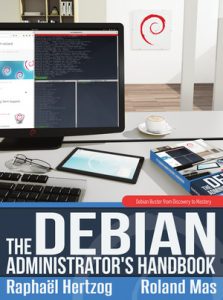
The Debian Administrator's Handbook CoverI am so glad that we managed to complete this project. Roland and I have spent countless hours on this book since December, both for the translation itself and also for all the things that we tend to forget: a nice book cover, a great book layout for the print version, coordinating the work of reviewers, registering as an editor to get an ISBN, etc. I think I will come back to this in a future article because some parts of the story are interesting.

In the mean time, enjoy the DFSG-free Debian Administrator’s Handbook:

  • get it from unstable with apt-get install debian-handbook;
  • browse the online version;
  • get the paperback or the ebook (available as PDF, EPUB, MOBI);
  • grab the sources with git clone git://anonscm.debian.org/debian-handbook/debian-handbook.git and contribute a translation :-)

Check out the official announce (there’s a discount for early buyers of the paperback).

My Debian Activities in April 2012

This is my monthly summary of my Debian related activities. If you’re among the people who made a donation to support my work (186.38 €, thanks everybody!), then you can learn how I spent your money. Otherwise it’s just an interesting status update on my various projects.

Dpkg News

For the first time since several years, there has been a dpkg release (1.16.3) where the changelog doesn’t contain any entry of my own. The 3-4 commits I did were not really worthy of a changelog entry. I must admit that it was easy to put dpkg aside given Guillem’s message and given how busy I have been with my other projects.

Keeping a low-profile for a while certainly doesn’t hurt. But I don’t intend to stop contributing to dpkg. Quite on the contrary in fact, it’s something that I (usually) enjoy doing.

Packaging News

I packaged a new upstream release of SQL-Ledger (3.0.0) and later in the month I sponsored the upload of LedgerSMB, a fork of SQL-Ledger which — unlike the former — is maintained like a typical free software project.

I also uploaded version 0.56 of Zim and updated WordPress to version 3.3.2 with its slew of security fixes.

The Debian Administrator’s Handbook

Like several months now, most of my time has been directed towards the Debian Administrator’s Handbook. The big news is that the liberation fund has been completed… this means that the book will be published under DFSG-free licenses from the start (GPL-2+ / CC-BY-SA 3.0).

We hope to publish the book next week (i.e. between May 7th and May 11th). The PDF output for the printed book is almost ready. There’s some work left for the HTML/EPUB output and we have to prepare for the release of the sources as well…

Hopefully everything will work out like planned. Stay tuned!

Thanks

See you next month for a new summary of my activities.

My Debian Activities in March 2012

This is my monthly summary of my Debian related activities. If you’re among the people who made a donation to support my work (227.83 €, thanks everybody!), then you can learn how I spent your money. Otherwise it’s just an interesting status update on my various projects.

Dpkg

Thanks to Guillem, dpkg with multiarch support is now available in Debian sid. The road has been bumpy, and it has again been delayed multiple times even after Guillem announced it on debian-devel-announce. Finally, the upload happened on March 19th.

I did not appreciate his announce because it was not coordinated at all, and had I been involved from the start, we could have drafted it in a way that sounded less scary for people. In the end, I provided a script so that people can verify whether they were affected by one of the potential problems that Guillem pointed out. While real, most of them are rather unlikely for typical multiarch usage.

Bernhard R. Link submitted a patch to add a new –status command to dpkg-buildflags. This command would print all the information required to understand which flags are activated and why. It would typically be called during the build process by debian/rules to keep a trace of the build flags configuration. The goal is to help debugging and also to make it possible to extract that information automatically from build logs. I reviewed his patch and we made several iterations, it’s mostly ready to be merged but there’s one detail where Bernhard and I disagree and I solicited Guillem’s opinion to try to take a decision. Unfortunately neither Guillem nor anyone else chimed in.

On request of Alexander Wirt, I uploaded a new backport of dpkg where I dropped the DEB_HOST_MULTIARCH variable from dpkg-architecture to ensure multi-arch is never accidentally enabled in other backports.

One last thing that I did not mention publicly at all yet, is that I contacted Lennart Poettering to suggest an improvement to the /etc/os-release file that he’s trying to standardize across distributions. It occurred to me that this file could also replace our /etc/dpkg/origins/default file (and not only /etc/debian_version) provided that it could store ancestry information. After some discussions, he documented new official fields for that file (ID_LIKE, HOME_URL, SUPPORT_URL, BUG_REPORT_URL). Next step for me is to improve dpkg-vendor to support this file (as a fallback or as default, I don’t know yet).

Packaging

I packaged quilt 0.60 (we’re now down to 9 Debian-specific patches, from a whopping 26 in version 0.48!) and zim 0.55.

In prevision of the next upstream version of Publican, I asked the Perl team to package a few Perl modules that Publican now requires. Less than two weeks after, all of them were in Debian Unstable. Congrats and many thanks to the Perl team (and Salvatore Bonaccorso in particular, which I happen to know because we were on the same plane during last Debconf!).

On a side note, being the maintainer of nautilus-dropbox became progressively less fun over the last months, in particular because the upstream authors tried to override some of the (IMO correct) packaging decisions that I made and got in touch with Ubuntu community managers to try to have their way. Last but not least, I keep getting duplicates of a bug that is not in my package but in the official package and that Dropbox did not respond to my query.

Book update

The translation is finished and we’re now reviewing the whole book. It takes a bit more time than expected because we’re trying to harmonize the style and because it’s difficult to coordinate the work of several volunteer reviewers.

The book cover is now almost finalized (click on it to view it in higher definitions):

We also made some progress on the interior design for the paperback. Unfortunately, I have nothing to show you yet. But it will be very nice… and made with just a LaTeX stylesheet tailored for use with dblatex.

The liberation fundraising slowed down with only 41 new supporters this month but it made a nice bump anyway thanks to a generous donation of 1000 EUR by Offensive security, the company behind Backtrack Linux. They will soon communicate on this, hopefully it will boost the operation. It would be really nice if we managed to raise the remaining 3000 EUR in the few weeks left until the official release of the book!

The work on my book dominated the month and explains my relative inactivity on other fronts. I worked much more than usual, and my wife keeps telling me that I look tired and that I should go in bed earlier… but I see the end of the tunnel: if everything goes well, the book should be released in a few weeks and I will be able to switch back to a saner lifestyle.

Thanks

See you next month for a new summary of my activities.

My Debian Activities in November 2011

This is my monthly summary of my Debian related activities. If you’re among the people who made a donation to support my work (310.73 €, thanks everybody!), then you can learn how I spent your money. Otherwise it’s just an interesting status update on my various projects.

Dpkg: Multi-Arch Saga

I know lots of people are waiting the landing of multiarch in Debian unstable, and so am I. Things are progressing, though not as quickly as I hoped. Guillem merged about half of the branch between the 24th October and the 6th of November. After that most of the work happened on his personal repository in his pu/multiarch/master branch.

I verify this repository from time to time because Guillem does not inform me when he has made progress. I noticed changes on his repository on the 10th, 19th, 23th, 28th of November and on the 1th of December.

He announced a long time ago that he had some “interface changes” and up to now only wrote about the switch from the command-line option --foreign-architecture (to put in /etc/dpkg/dpkg.cfg) to the explicit command dpkg --add-architecture that only needs to be called once (see mail here). As of today (December 2th), the promised email for the other interface changes is still not here.

On November 23th, I reviewed Guillem’s work and tried to run the code in his branch. I spent the whole day chasing up regressions and submitted lots of fixes to Guillem. Thanks to the extensive test-suite I wrote when I developed my branch, it has been fairly easy to track them all down.

All the issues I reported have been fixed in the latest version of Guillem’s branch although the fixes are often slightly different from those that I submitted.

Dpkg: Squeeze Backport

At the start of the month, I uploaded what I expected to be a fairly uncontroversial backport of dpkg 1.16.1.1. It turns out I was wrong.

After some discussion, I think we came to an agreement that it was acceptable to backport dpkg-dev and libdpkg-perl only. My goal was not to bring the latest dpkg to users but to make it easier for package maintainers to backport packages using new features provided by dpkg-dev >= 1.16 (such as hardening build flags, the makefile snippets provided in /usr/share/dpkg/, or the improved dpkg-buildflags interface).

Thus I modified the source package uploaded to squeeze-backports to build only dpkg-dev and libdpkg-perl. It has been uploaded on November 23th and it’s waiting in the NEW queue for a backports admin to process it.

Misc Dpkg Work

I merged a patch of Colin Watson to be able to verify build-dependencies for a foreign architecture (taking into account the Multi-Arch status of each package listed).

I released dpkg 1.16.1.2 with two minor fixes that were sitting in the sid branch. I wanted to get rid of this so that the path is clear for a 1.16.2 upload with multiarch. The package just migrated to testing so we’re fine.

I spent another day doing dpkg bug triaging on Launchpad, we’re now down to 77 bugs with many of them tagged as incomplete and likely to expire in 2 months.

The Debian Administrator’s Handbook

eBookWe released a sample chapter so that it’s easier to have an idea of the quality of the book. The chapter covers the APT tools quite extensively. I bet that even you could learn something about apt-get/aptitude…

The crowfunding campaign on Ulule ended on November 28th.
With 673 supporters, we raised 24345 EUR. Of those, 14935 EUR have been put in the liberation fund and the rest corresponds to the various pre-orders and rewards offered.

This means that the translation will happen (we just started) but that the book is currently not going to be released under a free license. Don’t despair… As planned, the liberation campaign is carried on until the 25 K€ target is reached!

Instead of being hosted on Ulule, this permanent campaign is on the project website at debian-handbook.info/liberation/. Note that any contribution of 10 EUR or more means that you get a copy of the ebook as soon as it’s available (even if the liberation target is not reached).

Package Tracking System

At the start of the month, I filed two ideas of improvements for the PTS in the bug tracking system: #647258 is about showing outstanding bugs that relate to a release goal and #647901 is about warning maintainers that the package is affected by a current transition. If you’re a coder and want to start contributing to Debian and its QA team, those bugs could be interesting targets for a start. :-) In both cases, I have been in contact with members of the release team because those ideas require some structured data from the release team as input. Thanks to Meddi Dohguy and Niels Thykier for their help.

Later in the month, the topic of relocating the PTS once again came up. For historical reasons, the PTS was hosted on master.debian.org together with the BTS. Nowadays the BTS has its own host and it made no sense anymore to have the PTS separate from the rest of the QA services hosted on qa.debian.org (currently quantz.debian.org). So together with Martin Zobel Helas we took care to plan the migration and on November 19th we executed the plan. It worked like a charm and almost nobody noticed (only one undocumented dependency was missed, which broke the SOAP interface).

Misc Packaging Work

WordPress was broken in Ubuntu and it was also not properly synchronized with Debian due to an almost useless change on their side. Thus I requested a sync so that the working version from Debian gets imported in Ubuntu.

I sponsored the docbook-xsl 1.76.1 upload that I needed for Publican. Then I updated Publican just to discover that the test-suite triggers a new bug in fop (filed as #649476). I disabled the test-suite temporarily and uploaded Publican 2.8 to unstable. BTW, I also filed 2 upstream bugs with patches for issues I discovered while trying to generate the sample chapter of my book (see here and here).

I uploaded a version 0.7.1 of nautilus-dropbox and fixed #648215 at the same time. I made an NMU of bison to fix a long-standing release critical bug that hit me once more during an upgrade (see #645038).

I uploaded to experimental a new version of gnome-shell-timer compatible with GNOME 3.2. I took the opportunity to install from experimental the few GNOME 3.2 packages which are not yet in unstable…

Thanks

See you next month for a new summary of my activities.

20 Things to Learn About APT With the Free Chapter of the Debian Administrator’s Handbook

We just released a sample chapter of the Debian Administrator’s Handbook. It covers the APT family of tools: apt-get, aptitude, synaptic, update-manager, etc.


Click here to get your free sample chapter

I’m sure you will enjoy it. There are many interesting things to learn:

  • How to customize the sources.list file
  • The various APT repositories that Debian offers (Security Updates, Stable Updates, Proposed Updates, Backports, Experimental, etc.)
  • How to select the best Debian mirror for you
  • How to find old package versions
  • How to install the same selection of packages on multiple computers
  • How to install and remove a package on a single command-line
  • How to reinstall packages and how to install a specific version of a package
  • How to pass options to dpkg via APT
  • How to configure a proxy for APT
  • How to set priorities to various package sources (APT pinning)
  • How to safely mix packages from several distributions on a single system
  • How to use aptitude’s text-mode graphical interface
  • How to use the tracking of automatically installed packages to keep a clean system
  • How APT checks the authenticity of packages that it downloads
  • How to add supplementary GnuPG keys to APT’s trusted keyring
  • How to upgrade from one stable distribution to the next
  • How to handles problems after an upgrade
  • How to keep a system up-to-date
  • How to automate upgrades
  • How to find the package that you’re looking for

If you liked this chapter, click here to contribute a few euros towards the liberation of the whole book. That way you’ll get a copy of the ebook as soon as it’s available. Thank you!

I also invite you to share this sample chapter as widely as possible. We’re only at 40% of the liberation fund and there’s less than 2 weeks left. I hope this book extract will convince enough people that the book is going to be great, and that it really deserves to be liberated and bundled with Debian!

My Debian activities in October 2011

This is my monthly summary of my Debian related activities. If you’re among the people who made a donation to support my work (130.30 €, thanks everybody!), then you can learn how I spent your money. Otherwise it’s just an interesting status update on my various projects.

Dpkg work

The month started with fixing newly reported bugs to prepare the 1.16.1.1 release:

  • #644492: there was a flaw in a change I made to the trigger setup code. This resulted in packages being incorrectly marked as configured while they were only unpacked in a new chroot.
  • #642656: dpkg-source’s refusal to build when it detects unrecorded changes broke the (mostly unused, except by the lintian test suite apparently) “2.0” source format.
  • #644412: the Makefile snippet “buildflags.mk” did not respect the new maintainer specific environment variables (like DEB_CFLAGS_MAINT_APPEND) because make does not forward environment variable through $(shell …). Fixed that by manually exporting the required variables.
  • I also disabled dpkg-buildpackage’s output of the build flags since it was confusing several maintainers. dpkg-buildpackage invokes debian/rules and it has no (clean) way to discover the build flags changes that maintainer request by setting the dedicated environment variables in debian/rules. Maintainers expect to see the build flags with the modifications they have requested and not just the default values set by the distribution.

With the help of Guillem, we decided on a proper fix for a race condition sometimes triggered by parallel builds when 2 concurrent dpkg-gencontrol try to update debian/files (see #642608). This ended up requiring a new package (libfile-fcntllock-perl) that the Debian perl team kindly packaged for us. With all this sorted, it was a rather easy fix.

Multiarch progress

I also spent lots of time on multiarch. I fixed an old bug that requested to support the multi-arch paths in case of cross-building (see #595144), the discussion was not really conclusive on which of the two proposed patches was better so I ended up picking my own patch because it was closer to how we currently deal with cross-building. Then I fixed 2 issues that have been reported on Ubuntu’s dpkg. The first one (LP #863675) was rather severe since an installed package ended being “disappeared” in favor of its foreign counterpart that was removed (but that had some config files left). The second one (LP #853679) only affected dselect users (apparently there are still some!) who had a self-conflicting library (Provides: foo, Conflicts: foo) installed for multiple architectures.

But the bulk of the time spent on multiarch has been spent discussing with various parties on how to go forward with multiarch. The release team commented on the schedule of the merge to ensure it makes it into Wheezy, and the Debian project leader also commented on the problems encountered so far.

While not the best course of action I could have hoped for, it certainly helped since Guillem started pushing some reviewed commits. Out of the 66 commits that were in my pu/multiarch/full branch one week ago, 20 have been merged in the master branch already.

Python-django security update and RC bug

Since python-django’s maintainer did not manage to prepare the required security updates, I stepped in and prepared version 1.2.3-3+squeeze2 for Squeeze and 1.0.2-1+lenny3 for Lenny. Unfortunately this security update is an example of how an inactive maintainer is likely to result in a severe delay for the release of security updates.

Furthermore in this specific case, the security team did not want to release the Squeeze security update until the Lenny one had been investigated (which required some time since upstream no longer supports the version in Lenny) but they did not make this very clear.

Later another release critical bug had been filed against the package (#646634) but after investigation, it turned out to be a local configuration problem so I downgraded it. I still forwarded the test suite failure to upstream authors since the test could be enhanced.

In any case, co-maintainers for python-django are welcome. I really preferred the situation where I can quietly sit down as backup maintainer… :-)

WordPress packaging

WordPress sounds similar to python-django. I’m also “only a backup maintainer” but Giuseppe has been inactive for many months and I had to step in August because I wanted the new upstream version. I discovered a bit late that I was not subscribed to wordpress’ bugs and thus the release critical bug #639733 (that I introduced with my new upstream version) went unattended for a rather long time. Once aware, though, I quickly fixed it.

I also took the opportunity to start a discussion on debian-devel about how to deal with embedded javascript libraries and proposed a mechanism of “opportunistic replacement with symlinks”. WordPress is my testbed package for this mechanism, you can check out its debian/dh_linktree that implements the replacement logic.

The discussion has not been very interesting but at least I learned that Debian now requires that each source package shipping minified javascript files includes the original files too. It’s somewhat of a pain since it’s not a license requirement in many cases (many of those libraries are not under the GPL), but just a Debian requirement that many upstreams are not complying with. WordPress is affected and Jakub Wilk thus opened #646729 which is going to be a long-standing RC bug. To give good measures, I spent several hours investigating the case of each javascript file in the WordPress source package and I filed a new ticket on the upstream bugtracker.

Dropbox packaging work

A few months after the introduction of nautilus-dropbox to Debian and Ubuntu, I can say that the decision to only support the download of dropbox in the postinst has been a mistake. Because of this decision I had to make the postinst fail if the download failed. Even if the error message is relatively clear, this lead to many (mostly automated) bug reports on the Ubuntu side. Various other problems cropped up on top of this (trying to start dropbox while the package was not configured would result in an error because the user did not have the required rights to install the software, reinstalling the package while dropbox was running would result in a failure too, etc.).

I have fixed all those issues in the version 0.7.0-2 of the package. Now if the user has to install dropbox, it will use PolicyKit to request the root rights. The postinst will no longer fail if the dropbox download fails since it can be run later by the user. And I fixed the download code to remove the replaced file before unpacking a new file (insead of overwriting the existing file). All this work has been forwarded upstream.

The Debian Administrator’s Handbook Update

I’m glad to tell you that the translation will happen because we reached the minimal funding goal on October 22th with the help of 380 supporters.

Now the fundraising continues, but this time the goal is the liberation of the resulting book. For this to happen, we need to reach 25000 EUR in the liberation fund. So far we’re at 37% of this goal with 9400 EUR in the liberation fund (which means that 59% of the money raised has been put in the liberation fund).

Click here if you want to contribute towards the liberation of this book.

With (less than) 27 days left, it’s going to be a challenge to meet the goal, but we do like challenges, don’t we?

Misc work

  • I filed #644486 against dh-make so that new packages have proper support of dpkg-buildflags from the start.
  • I merged lots of patches from Luca Falavigna in the developers-reference.
  • I discussed debtags integration in the PTS with Enrico Zini and Paul Wise.
  • I updated publican’s packaging for the new upstream version 2.8. I had to write a new patch that I forwarded upstream.
  • I filed an upstream bug on hamster-applet because just running hamster-time-tracker no longer brings its window forward.

Thanks

See you next month for a new summary of my activities.