
apt-get install debian-wizard

Insider infos, master your Debian/Ubuntu distribution

  • About
    • About this blog
    • About me
    • My free software history
  • Support my work
  • Get the newsletter
  • More stuff
    • Support Debian Contributors
    • Other sites
      • My company
      • French Blog about Free Software
      • Personal Website (French)
  • Mastering Debian
  • Contributing 101
  • Packaging Tutorials
You are here: Home / Archives for Random

The secret plan behind the “3.0 (quilt)” Debian source package format

October 21, 2010 by Raphaël Hertzog

New source package formats do wondersWhile I have spent countless hours working on the new source format known as “3.0 (quilt)”, I’ve just realized that I have never blogged about its features and the reasons that lead me to work on it. Let’s fix this.

The good old “1.0” format

Up to 2008, dpkg-source was only able to cope with a single source format (now named “1.0”). That format was used since the inception of the project. While it worked fine for most cases, it suffered from a number of limitations—mainly because it stored the Debian packaging files as a patch to apply on top of the upstream source tarball.

This patch can have two functions: creating the required files in the debian sub-directory and applying changes to the upstream sources. Over time, if the maintainer made several modifications to the upstream source code, they would end up entangled (and undocumented) in this single patch. In order to solve this problem, patch systems were created (dpatch, quilt, simple-patchsys, dbs, …) and many maintainers started using them. Each implementation is slightly different but the basic principle is always the same: store the upstream changes as multiple patches in the debian/patches/ directory and apply them at build-time (and remove them during cleanup).

Design goals for the new formats

When I started working on the new source package format, I set out to get rid of all the known limitations and to integrate a patch system in dpkg-source. I wanted to clear up the situation so that learning packaging only requires to learn one patch system and would not require modifying debian/rules to use it. I picked quilt because it was popular, came with a large set of features, and was not suffering from NIH syndrome. This lead to the “3.0 (quilt)” source format.

I also created “3.0 (native)” as a distinct format. “1.0” was able to generate two types of source packages (native and non-native) but I did not want to continue with this mistake of mixing both in a single format. The KISS principle dictated that the user should pick the format of his choice, put it in debian/source/format and be done with it. Now the build can rightfully fail when the requirements are not met instead of doing something unexpected as a fallback.

Features of “3.0 (quilt)”

This is the format that replaces the non-native variant of the 1.0 source format. The features below are specific to the new format and differentiate it from its ancestor:

  • Supports compression formats other than gzip: bzip2, lzma, xz.
  • Can use multiple upstream tarballs.
  • Can include binary files in the debian packaging.
  • Automatically replaces the “debian” directory present in the upstream tarball (no repacking required).
  • Creates a new quilt-managed patch in debian/patches/ when it finds changes to the upstream files.

Features of “3.0 (native)”

This format is very similar to the native variant of the 1.0 source format except for two things:

  • it supports compression formats other than gzip: bzip2, lzma, xz.
  • it excludes by default a bunch of files that should usually not be part of the tarball (VCS specific files, vim backup files, etc.)

Timeline

Looking back at the history is interesting. This project already spans multiple years and is not really over until a majority of packages have switched to the new formats.

  • January 2008: the discussion how to cope with patches sanely rages on debian-devel@lists.debian.org. My initial decisions are the result of this discussion.
  • March 2008: I have implemented the new formats and I request feedback. dpkg 1.14.17 (uploaded to experimental) is the first release supporting them.
  • April 2008: I ask ftpmasters to support the new source packages in #457345.
  • June 2008: Lenny freeze. dpkg is not supposed to change anymore. Several changes concerning the new source formats are still accepted in the following months given that this code is not yet used in production and must only be present so that lenny can cope with new source packages once squeeze starts using them.
  • February 2009: Lenny release.
  • March 2009: Work on squeeze has started, ftpmasters have done nothing to support new source formats, I submit a patch in #457345 to speed things up. I start a wiki page to track the project’s progress and to answer common questions of maintainers.
  • November 2009: After an ftpmaster sprint, it’s now possible to upload new source packages in unstable. This draws massive attention to the new format and some people start complaining about some design decisions. The implementation of “3.0 (quilt)” changes a lot during this month. dpkg in lenny is even updated to keep up with those changes.
  • March 2010: Up to now, I was planning to let dpkg-source build new source packages by default at some point in the future. After several rounds of discussions, I agree that it’s not the best course of action and decides instead to make debian/source/format mandatory. The maintainer must be explicit about the source format that s/he wants to use.
  • October 2010: The new source formats are relatively popular, a third of the source packages have already switched: see the graph. The squeeze freeze in August clearly stopped the trend, hopefully it will continue once squeeze is released.
  • June 2013: Project is finished?

As you can see this project is not over yet, although the most difficult part is already behind me. For my part, the biggest lesson is that you won’t ever get enough review until your work is used within unstable. So if you have a Debian project that impacts a lot of people, make sure to organize an official review process from the start. And specifying your project through a Debian Enhancement Proposal is probably the best way to achieve this.

If you appreciate the work that I put into this project, feel free to join Flattr and to flattr dpkg from time to time. Or check out my page “Support my work“.

5 reasons why I still contribute to Debian after 12 years

October 11, 2010 by Raphaël Hertzog

Debian is packaging the free sofware world.If you’re using Debian, you know that this distribution is built entirely by volunteers that form a very diverse community. And you could be part of it. But why should you do that? I can’t tell for you but I can share my own experience. It’s been 12 years since I joined Debian and I’m going to tell you what keeps me on board.
1. Technical excellence

When facing a new challenge, Debian will strive to do the right thing. This pays off in the long term. In many cases, it means that we will take more time to implement our solution compared to other distributions out there, but this is also the reason why our packaging infrastructure allows us to offer painless upgrades and consistency across all packages.

Debian is committed to quality and builds up on his experience thanks to the Debian Policy. My time is precious, I like to spend it on something useful in the long term.

2. Inspiring goals

In its social contract, Debian has set out to create a 100% free — as in freedom — operating system. The criteria defining what constitutes a free work are listed in the Debian Free Software Guidelines (DFSG).

While the above is relatively ambitious in itself, it doesn’t inspire me much. What makes the difference to me is the emphasis given by the social contract on our users and free software. We don’t build a free operating system in the void, we build it for people.

Debian’s motto — the universal operating system — can also be interpreted in multiple ways: universal as in “for everybody on the world”, “on all kinds of computers”, or “for every possible usage”.

3. High impact work

Knowing that my work is useful to people is important, but it’s even better when I know that it will benefit to lots of people. With Ubuntu and the hundreds of other derivatives, there are nowadays literally millions of users impacted by my work. Even an insignificant one second improvement experienced by 10 millions of people represent 115 days of time saved for something else, you get the idea…

4. Working with great people

Debian has the chance to have lots of smart people on board. There’s always someone sharing valuable advice when you read Debian’s mailing lists. When I joined in 1998, I was a real newbie and I learned a lot of things by reading and interacting with people more knowledgeable than me. You can still experience the same thing nowadays but there’s one caveat: you must cope with various kinds of mailing list contributors including the “smart but uncivilized” (don’t be offended too quickly!) and the occasional troll (best ignore it, don’t feed it!).

5. Recognition of work

When you contribute to Debian, people get to know you through your contributions. It’s very rewarding to be thanked by your peers and by Debian’s users. Check out thanks.debian.net to convince you that many people are grateful for the work we put into Debian.

So that’s it for me. But what about you? What motivates you to contribute year after year, or to start contributing if you’re a prospective contributor?

Subscribe to this blog (it’s free!) by RSS, by email, or on Facebook.

Can Debian achieve world domination without being on Facebook?

September 9, 2010 by Raphaël Hertzog

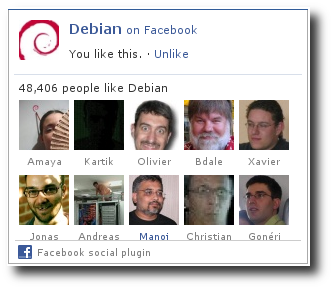
Debian Developers who like Debian on FacebookFacebook is not very popular among free software hackers. When I announced my Facebook page on identi.ca (see here) I got a few replies suggesting it was odd for me to use Facebook.

Indeed there are many good reasons why Facebook should be avoided: it is a centralized and proprietary service that is not very privacy-friendly. But the truth is that lots of people are using it (even Debian developers, can you recognize them on the picture?) and some are using their Facebook news feed as their main source of news.

You might wonder how many persons that represents, so here are the figures: the Debian Facebook page has 48,361 fans and the Ubuntu one has 247,932 fans. That’s right, an announce put on the Debian facebook page would reach more persons than the most popular announce list that Debian is currently running (debian-announce@lists.debian.org has about 29,000 subscribers). Unfortunately that Debian Facebook page is empty and I don’t even know who the administrator is. The Ubuntu page on the contrary is properly configured to relay news from The Fridge and Jono Bacon is posting some custom updates from time to time.

Debian contributors regularly mention “world domination” as the ultimate goal of the universal operating system (I even feature this in my blog header banner! :-)). But working towards world domination means — in my opinion — that we should communicate our ideals of freedom to as many people as possible, even if they are using a service that we don’t want to promote.

The Debian social contract acknowledges that some users have to use non-free software and we provide the non-free section for them. In the same spirit, I believe we must have a presence on Facebook. That does not mean that we endorse Facebook, and we should surely promote Joindiaspora once it’s usable. But in the mean time we should reach out to Facebook users and allow them to follow us with the platform of their choice.

That’s the choice I recently made when I decided to setup a public facebook page featuring my free software work, my blog and my book. So if you are a Facebook user, click here to visit my page and click on “Like” if you want to follow this blog in your Facebook news feed. I also share interesting Debian or Ubuntu related articles that I discover while reading my RSS subscriptions.

Below are the usual facebook widgets for the 3 pages quoted in this article (they might not show up if you read this article through an RSS feed):


About the Debian Community Poll

June 11, 2010 by Raphaël Hertzog

While I find the idea interesting, several of the questions can’t be correctly answered because the proposed choices are not realistic or too limited.

On the question of the usage of money, I believe we should spend money to fund important projects but I don’t want to fund “people having important positions in Debian and doing important work”. What should I reply? (Granted, there’s the other item but that doesn’t help getting a clear picture of the answers)

On the question “Do you prefer time based releases instead of the «it’s ready when it’s ready» releases?”, it is putting two concepts in opposition when the release managers recently proposed a third way that combines both: “time based freezes and release when it’s ready”. This is what I want and I can’t adequately express it either in the current poll.

  • « Previous Page
  • 1
  • …
  • 3
  • 4
  • 5
  • 6
  • 7
  • …
  • 15
  • Next Page »

Get the Debian Handbook

Available as paperback and as ebook.
Book cover

Email newsletter

Get updates and exclusive content by email, join the Debian Supporters Guild:

Follow me

  • Email
  • Facebook
  • GitHub
  • RSS
  • Twitter

Discover my French books

Planets

  • Planet Debian

Archives

I write software, books and documentation. I'm a Debian developer since 1998 and run my own company. I want to share my passion and knowledge of the Debian ecosystem. Read More…

Tags

3.0 (quilt) Activity summary APT aptitude Blog Book Cleanup conffile Contributing CUT d-i Debconf Debian Debian France Debian Handbook Debian Live Distro Tracker dpkg dpkg-source Flattr Flattr FOSS Freexian Funding Git GNOME GSOC HOWTO Interview LTS Me Multiarch nautilus-dropbox News Packaging pkg-security Programming PTS publican python-django Reference release rolling synaptic Ubuntu WordPress

Recent Posts

  • Debian’s General Resolution on AI and LLM
  • How to choose your SSH agent with Wayland and systemd
  • Freexian is looking to expand its team with more Debian contributors
  • Freexian’s report about Debian Long Term Support, July 2022
  • Freexian’s report about Debian Long Term Support, June 2022

Copyright © 2005-2021 Raphaël Hertzog