apt-get install debian-wizard

Insider infos, master your Debian/Ubuntu distribution

  • About
    • About this blog
    • About me
    • My free software history
  • Support my work
  • Get the newsletter
  • More stuff
    • Support Debian Contributors
    • Other sites
      • My company
      • French Blog about Free Software
      • Personal Website (French)
  • Mastering Debian
  • Contributing 101
  • Packaging Tutorials
You are here: Home / Archives for Debian

My Debian activities in May 2011

June 3, 2011 by Raphaël Hertzog

This is my monthly summary of my Debian related activities. If you’re among the people who made a donation to support my work, then you can learn how I spent your money. Otherwise it’s just an interesting status update on my various projects.

I have been…

Doing some work towards Debian Rolling

At the start of the month, the discussions about Debian rolling were still very active on debian-devel. Declaring that testing would be rolling did not make it (as I hoped), the argument that some RC bugs last for far too long in that distribution carried the discussion and thus the most consensual proposition ended up being the one of Josselin Mouette were rolling would be testing plus a few selected cherry-picked packages from unstable.

I believe it’s a workable solution if we only care about a subset of architectures. Otherwise the same reasons that keep the fixed packages out of testing would probably also apply for rolling.

Given this, I did setup britney (the software that controls testing) on my laptop to investigate how we can create rolling. It turns out britney is a very specialized software with very few configuration knobs.

At the same time Joachim Breitner made a proposition that immediately grabbed my attention. He suggests to use SAT solvers to find out the set of packages that should migrate from unstable to testing. I thought that rolling would be a good testbed for this new implementation of britney (which he calls SAT-britney) so I jumped right in this project.

I was not at all familiar with this science field, so I looked up quite some documentation: I learned that all SAT solvers expect the problem to be presented in CNF form, and that DIMACS was the file format of choice to represent those boolean constraints. Several SAT solvers are available in Debian and picosat appears to be one of the best.

Then I started some early coding/prototyping to play with the concept. You can find the result in this git repository, you can grab a copy with git clone git://git.debian.org/~hertzog/sat-britney.git.

There’s not much yet, except some Python code to generate a SAT problem that can be fed to a SAT solver. But I really look forward to this project.

Representing Debian during Solutions Linux

During the second week, I spent 3 days in Paris to help manage the Debian booth at Solutions Linux.

We have responded to lots of queries but most visitors already knew Debian, and many of them use it at work and/or at home. We tried to recruit those people as new members for Debian France, the local association. We also sold all our remaining goodies.

The Ubuntu people were interviewed by France 3 (an important TV channel) and we took this opportunity (with the consent of the Ubuntu guys) to show our Debian t-shirts in the background: you can watch the video here (in French), you can see me with Carl Chenet at 1:21.

We have also been interviewed by Intelli’n TV: here and here (both in French). I’m not very good at this exercise. 🙂

Improving dpkg triggers

The third week was a vacation week, in theory I should have stayed away from my computer but I really wanted to take this opportunity to improve the state of dpkg triggers in Debian.

I already covered my work in another article: Trying to make dpkg triggers more useful and less painful.

The result is not merged yet, I just asked a question to all package maintainers who are using triggers to be able to decide whether I’ll merge it as is, or if I can make the new behavior the default one.

Supporting users after Alioth’s migration

When I came back from my vacation, many services provided by Alioth.debian.org were non-functional after a migration to a new setup that involves two machines instead of one. Given that I used to be an Alioth admin, I know that in those periods you tend to be get bogged down on many user support requests. So I re-joined #alioth on IRC and tried to help a bit.

I did investigate some of the reported problems and prepared fixes (updated scripts, configuration files, etc.) for some of the issues. I also created a list of remaining issues that should have lasted only a few days but that’s still active because there are still regressions left.

The most important things still missing are:

  • proper support for delegation of rights. We used ACL setup by the admins in the past. With the new FusionForge, each project admin should be able to delegate rights to external “roles”. There’s a Debian Developer role already but trying to grant him right fails…
  • access to the Ultimate Debian Database. Many tools rely on this database to work.
  • anonymous FTP access to download project files.
  • clear guidelines on how we’re supposed to deal with websites that are updated by VCS hooks.
  • clear guidelines on how we’re supposed to deal with personal git repositories

Improving the “3.0 (quilt)” source format

I have made some proposals to change the way the new source format would work. The goals are to be less painful for packagers who are using a VCS, and to avoid unexpected changes slipping through a new patch generated by dpkg-source.

It seems that the proposals are relatively consensual so I’ll implement them at some point.

Missing in action on my blog

I did a lots of stuff for Debian between travel and vacation, and in the remaining time, I did not manage to write many articles for my blog.

In fact, besides the article on my triggers work mentioned above I only published one interview: People behind Debian: Steve Langasek, release wizard.

I’ll try to do better this month!

Thanks

Many thanks to the people who gave me 151.61 € in May.

See you next month for a new summary of my activities.

Trying to make dpkg triggers more useful and less painful

May 30, 2011 by Raphaël Hertzog

Lately I have been working on the triggers feature of dpkg. I would like to share my plan and what I have done so far. I’ll first explain what triggers are, the current problems, and the work I did to try to improve the situation.

Introduction

Dpkg triggers are a neat feature of dpkg that package can use to send/receive notifications to/from other installed packages. Those notifications take the form a simple string.

This feature is heavily used to track changes of packaged files in a list of predefined directories, and to update other files based on this. For instance, man-db is watching the directories containing manual pages so that it can update its cache (in /var/cache/man/). install-info is updating the index of info pages when there have been changes in /usr/share/info. gnome-menus is updating its own copy of the menu hierarchy (with entries from /etc/gnome/menus.blacklist blacklisted) every time that a .desktop file is installed/updated/removed.

From a user’s perspective

You see triggers in action very often during upgrades (in fact too often as we’ll see it later):

Preparing to replace zim 0.52-1 (using .../archives/zim_0.52-1_all.deb) ...
Unpacking replacement zim ...
Processing triggers for shared-mime-info ...
Processing triggers for menu ...
Processing triggers for desktop-file-utils ...
Processing triggers for man-db ...
Processing triggers for hicolor-icon-theme ...
Processing triggers for python-support ...
Processing triggers for gnome-menus ...
Setting up zim (0.52-1) ...
Processing triggers for python-support ...
Processing triggers for menu ...

As you guessed it, those “Processing triggers” lines correspond to the packages which received (one or more) trigger notifications and which are doing the corresponding task.

By default the triggers are processed at the end of the dpkg --unpack invocation which is often too soon because APT will often call dpkg --unpack repeatedly during important upgrades. There are some options to ask APT to use dpkg’s --no-triggers option in order to defer the trigger processing at the end of the APT run. You can put this in /etc/apt/apt.conf.d/triggers:

// Trigger deferred
DPkg::NoTriggers "true";
PackageManager::Configure "smart";
DPkg::ConfigurePending "true";
DPkg::TriggersPending "true";

I have now asked APT maintainers to use those options by default, I filed bug #626599 to track this. At the same time I fixed bug #526774 reported by APT maintainers. This bug forced them to put a work-around in APT which resulted in running triggers sooner than expected.

(And while writing this article I filed bug #628564 and #628574 because it was clearly not normal that the menu triggers was executed twice for the installation of a single package)

From a packager’s perspective

The implementation of triggers has several consequences on the status that packages can have.

Let’s assume that the package A installs a file in a directory that is watched by package B (and that B is currently in the “installed” state). When A is unpacked, dpkg adds B to its “Triggers-Awaited” field and lists the activated trigger in B’s “Triggers-Pending” field. Package A is in “unpacked” state, but B has been changed to “triggers-pending”.

When A is configured, instead of going to the “installed” state, it will go to the “triggers-awaited” state. In that state the package is assumed to NOT fulfill dependencies. However, B—which is still in “triggers-pending” state—does fulfill dependencies.

A and B will switch to “installed” at the same time when the trigger has been processed.

The fact that the triggers-awaited status does not fulfill dependencies means that some common triggers like man-db have to be processed regularly just to be able to ensure dependencies are satisfied before running the postinst of other installed packages.

But a package which ships a manual page can certainly be considered as configured when its postinst has been run even if man-db has not yet updated its cache to know about the new/updated manual page.

When you activate a trigger with the dpkg-trigger command you have an option --no-await to avoid awaiting the trigger processing (and thus to go directly to installed state after the postinst has been run). But with file triggers or activate trigger directives, you do not have this option.

My proposal to improve the situation

This is the problem that I tried to solve during my last vacation. But before changing the inner working of triggers, I wrote a non-regression test suite for that feature (commit here) so I could hack with some confidence that I did not break everything.

The result has been presented on the debian-dpkg mailling list: see the discussion here. I added new directives that can be used in triggers files that work exactly like the current triggers except that they do not put triggering packages in trigger-awaited status.

I believe the code to be mostly ready, but in its current form the patch brings zero benefits until all packages have been converted to use the trigger variants that do not require awaiting trigger processing (and the change requires a pre-dependency on dpkg to ensure we have the required dpkg that understands the new kind of trigger directives).

Remaining question

Thus I wonder if I should not change the default semantic of triggers. The packages which really provide crucial functionality to awaiting packages through triggers would then have to be updated to switch to the new directives.

If you’re a packager using triggers, you can thus help me by answering this question: do you know some triggers where it’s important that the awaiting packages are not considered as configured before the trigger processing? In most of the cases I checked, it’s important for the triggered package rather than for the triggering package.

In truth, a package in triggers-awaited status is usually in a good enough shape to be able to satisfy dependencies (i.e. requirements that other packages can have), but it would still be worth to record the fact that it’s not entirely configured yet because it might be true from the user’s point of view: for example if the menu trigger has not yet been processed, the software might not yet be visible in the application menu.

If you appreciate this kind of groundwork that benefits to the whole Debian ecosystem, please consider supporting my work. Click here and give it a look, there are many ways to contribute and to make a difference for me.

Solutions Linux this week, DebConf this summer

May 9, 2011 by Raphaël Hertzog

As announced on my French blog, I’m attending Solutions Linux this week (10-12 May). I’ll be on the Debian booth with a few other members of Debian France.

If you’re in Paris during those days, make sure to come by. I’ll be pleased to meet you, and we’ll be a bunch of Debian contributors ready to answer your questions. And if you feel like it, feel free to stop for a few hours and give us some help at the booth. It tends to be crowded and we’re never enough to answer the questions.

As usual, I’ll come with a copy of the book Cahier de l’Admin Debian (the one that I want to translate into English) to show, and I’ll be glad to dedicate the book to whoever brings his copy with him/her.

While speaking of conferences, this summer I’m going to Banja Luka for DebConf 2011. I’ve bought my plane tickets and I’ll be there the whole week (24-31 july).

Joining a DebConf is a completely different experience. DebConf is made by Debian people for Debian people. It’s an opportunity to meet many of the people that you mainly know over IRC/email.

And you don’t need to be a hardcore Debian contributor to join. In fact, it’s a great experience for anyone who just started contributing to Debian. Read this email of Asheesh Laroia as a proof. Note that the sponsored registration period has been extended up to the 17th of May. Register now!

I’m looking forward to DebConf11. On request of Stefano, I registered a Debian Rolling Bof. It will be a good occasion to see how far we are and to discuss future plans.

People behind Debian: Steve Langasek, release wizard

May 6, 2011 by Raphaël Hertzog

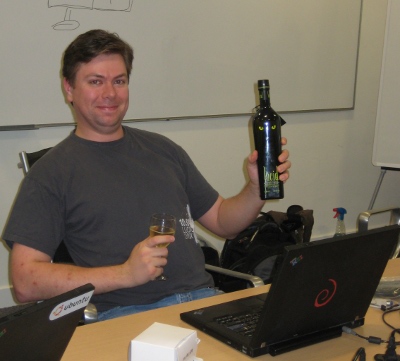
Steve Langasek has been contributing to Debian for more than a decade. He was a release manager for sarge and etch, and like many former release managers, he’s still involved in the Debian release team although as a release wizard (i.e. more of an advisory role than a day-to-day contributor). Oh, and he did the same with Ubuntu: on the picture on the left, he just announced the release of Ubuntu 10.04 from his Debian-branded laptop. 😉

He has also been maintaining PAM in Debian for as long as can I remember and does a great job at that. He’s very knowledgeable and fully deserves his place within the Debian Technical Committee. I’m glad he still has the time to participate on several important Debian mailing lists because his contributions are always very useful.

I’m sure you’ll notice this just by reading his answers below. My questions are in bold, the rest is by Steve.

Who are you?

I’m 32 years old, have been running Linux since my first year in college back in ’96, and have been a Debian developer now for ten years. Along the way I’ve been involved in maintaining a variety of server packages, worked on the Alpha port for a while, did a stint as a release manager for a couple of years, and serve on the technical committee.

This year I’m also celebrating my ten year anniversary with my lovely wife Patty, who many know as an erstwhile front-desk volunteer at DebConf. God only knows why she puts up with my late-night hacking!

These days in my day job I’m a manager on the Ubuntu Platform team at Canonical, working to help make Ubuntu a daughter distribution that the Debian community can be proud of.

What’s your biggest achievement within Debian or Ubuntu?

There’s no doubt that my biggest achievement in Debian has been overseeing the release of two Debian releases as release manager.

On the other hand, the scope of a release is so huge, and it represents the output of so many developers working together, that it would be arrogant to claim the release itself as an achievement of my own. Also, sarge and etch have long since been rotated off of the mirrors so no one cares about them anymore. 😉 For a more personal and lasting contribution in the distro itself, I’m very proud of writing pam-auth-update. It’s a small piece of code, but one that Debian was missing for a long time – it’s made a big difference to PAM module integration in packages!

What are your plans for Debian Wheezy?

My top priority for this cycle is to see multiarch through. We’re still not far enough along in Debian for most developers to see any difference… and once we are, the first thing people are going to see is a fair bit of breakage when we start breaking a lot of assumptions about paths that have been hard-coded upstream. But I’m still excited by the progress that is being made here. We should be able to ship wheezy without any ia32-libs package. We might even be able to get rid of all the biarch library packages, including those used by the toolchain itself. 54 packages in testing build-depend on gcc-multilib right now, in order to build 32-bit code to ship in the amd64 package; a bunch of those should go away with absolutely no reduction in functionality, saving us a bit of space in the archive and saving the maintainers a lot of complexity in their packages, while at the same time giving us much better support for cross-compilation than we’ve ever had before.

It’s a tall order, certainly, but the pieces are falling into place one by one.

My second priority is to get a policy in Debian around packages integrating upstart jobs. It would of course benefit Ubuntu to have many packages back in sync with Debian, but if all we wanted was to sync with Debian, we could mostly just make debhelper ignore upstart jobs in Debian, prefer them in Ubuntu, and call it good. I’m interested in making sure Debian also gets the benefits of being able to use upstart, because as Linux has become increasingly asynchronous (doing more in parallel at start up), the traditional sysvinit has not been able to keep up. There are all kinds of bugs now related to network startup, for instance, that we don’t have a good answer for in a sysvinit model but that we can fix with an event-based system.

Upstart has been around for a while now, but we’ve been slow to integrate it into Debian because it only works on Linux. It would be a shame if right after the first Debian GNU/kFreeBSD technology preview, packages all stopped working on kFreeBSD because they started to assume the availability of upstart! Unfortunately, having been so cautious we now have systemd on the scene, which not only doesn’t support non-Linux but seems to be in the process of trying to gobble up other, non-Linux-specific components of the desktop stack. So I have to wonder what the future holds for the free desktop on non-Linux kernels.

If you could spend all your time on Debian, what would you work on?

Well, based on my previous experiences when I did spend all my time on Debian, I think the answer here is QA / release work. 🙂 Otherwise, I don’t know. My hands are full enough now with multiarch that it’s hard for me to see what the Next Thing would be.

You’re a member of the technical committee. In the interview of Bdale Garbee, I have argued that it’s not working well. What’s your point of view on this topic?

Well, I feel a constant low level guilt about my own poor level of activity in the TC; but that doesn’t translate into a belief that the system is broken. This is, after all, the decision making body of last resort for technical disputes in Debian, and as such it should really be used sparingly. And if a reputation for glacial deliberation means more developers work out their disputes on their own rather than asking the TC to step in, I think that’s actually a healthy thing!

I do still wish we were more effective at resolving those issues that do come our way, but there’s no silver bullet for this. Though the funny thing is, I’ve noticed that the majority of issues that get referred to the TC nowadays never even need us to make a decision; a short conversation with the disputants is often enough to get them to come to an agreement.

What’s the biggest problem of Debian?

By and large, I think Debian is still doing a great job at what it’s best at — delivering a rock-solid distribution that users can rely on. If I would highlight one problem in Debian, though, it would be that I think we’re becoming less innovative as time goes on. Part of that comes from being such a large project that we’re bound to be more conservative as an institution; but even though the three pet Debian projects of mine that I mentioned above are fairly innovative (multiarch, pam-auth-update, upstart), each of these has landed first in Ubuntu rather than in Debian. Always with a clear intent of pushing back up into Debian, of course, but it just wasn’t possible to do this work within Debian for the first cut without much longer delays.

I worry that if Debian is no longer the place to try new things, that we’re going to miss out on attracting contributions from the folks who are inspired to make Free Software better – and not simply to make it stable.

I’m not sure how to address this, though. Maybe improved conversations with derivatives such as (but not limited to) Ubuntu, about what crack of the day is being tried where and how that can be integrated into Debian once it’s proven to work? I don’t think that team-based maintenance or low-threshold NMUs do anything to address this, though, as the kinds of innovation that matter most are ones that require discussion and consensus-finding — not just routing around inactive maintainers.

Do you have wishes for Debian Wheezy?

Well, I’d like to see the armhf port get on its feet and become an official port. Over the lifetime of the arm and armel ports, the state of the art on ARM has changed quite a bit; it would be great to see Debian taking advantage of this richer platform, to let people make better use of their hardware via Debian.

As a former release manager, you’re now a “release wizard”. I guess you have seen it on debian-devel, there are proposals to not freeze testing and to use another distribution starting as a snapshot of testing to finalize the new stable release. According to your experience, what needs to happen to make this possible?

Frankly, I’ve stayed out of that discussion because I don’t think what’s being asked for is possible. I think proponents of a freezeless release have seriously underestimated the amount of work required on the part of the release team to wrangle testing into a releasable product, and that anything that makes propagation of fixes into the pending release more time consuming will make Debian worse on the whole, not better.

If people really want to avoid long freezes for the Debian release, the best way they can help this happen is by making Debian more releasable on an ongoing basis, by helping to hold our packages to our shared standards for quality (i.e., by fixing RC bugs!). The biggest factor in long freezes for Debian is the slow rate at which we bring the RC bug count down during the freeze. Back in the sarge, etch days we used to have really great bug squashing parties that would get people together on weekends to hack through RC bugs by the dozens. I don’t see that happening as much anymore. I’d really like us to get back to that, but my few attempts at this so far since retiring as release manager have led me to think I’m really terrible at organizing parties of any kind. 🙂

On the other side, as seen at http://bugs.debian.org/release-critical/, the RC bug count for testing at the beginning of the release cycle keeps getting higher and higher. I’d love to know why that is so we can address it. I know we’ve gotten better at detecting some classes of RC bugs; that’s part of it, but I don’t think it explains the whole trend.

Is there someone in Debian that you admire for their contributions?

Wow, what kind of arrogant jerk would I be if I didn’t admire anyone in Debian for their contributions? Debian is and always has been an amazing community of top-notch developers; there are certainly too many I admire to list them all here. Joey Hess certainly makes the list, for his longstanding example of code speaking louder than words and for his ability to get to the heart of common problems and come up with elegant solutions. So does Russ Allbery, who by all accounts had his ability to feel anger in response to email burned out of him at a young age in a flame-related accident on Usenet. 😉 The list goes on, but here I think I have to follow Joey’s example and cut the words short.


Thank you to Steve for the time spent answering my questions. I hope you enjoyed reading his answers as I did. Subscribe to my newsletter to get my monthly summary of the Debian/Ubuntu news and to not miss further interviews. You can also follow along on Identi.ca, Twitter and Facebook.
  • « Previous Page
  • 1
  • …
  • 60
  • 61
  • 62
  • 63
  • 64
  • …
  • 95
  • Next Page »

Get the Debian Handbook

Available as paperback and as ebook.
Book cover

Email newsletter

Get updates and exclusive content by email, join the Debian Supporters Guild:

Follow me

  • Email
  • Facebook
  • GitHub
  • RSS
  • Twitter

Discover my French books

Planets

  • Planet Debian

Archives

I write software, books and documentation. I'm a Debian developer since 1998 and run my own company. I want to share my passion and knowledge of the Debian ecosystem. Read More…

Tags

3.0 (quilt) Activity summary APT aptitude Blog Book Cleanup conffile Contributing CUT d-i Debconf Debian Debian France Debian Handbook Debian Live Distro Tracker dpkg dpkg-source Flattr Flattr FOSS Freexian Funding Git GNOME GSOC HOWTO Interview LTS Me Multiarch nautilus-dropbox News Packaging pkg-security Programming PTS publican python-django Reference release rolling synaptic Ubuntu WordPress

Recent Posts

  • Debian’s General Resolution on AI and LLM
  • How to choose your SSH agent with Wayland and systemd
  • Freexian is looking to expand its team with more Debian contributors
  • Freexian’s report about Debian Long Term Support, July 2022
  • Freexian’s report about Debian Long Term Support, June 2022

Copyright © 2005-2021 Raphaël Hertzog