apt-get install debian-wizard

Insider infos, master your Debian/Ubuntu distribution

  • About
    • About this blog
    • About me
    • My free software history
  • Support my work
  • Get the newsletter
  • More stuff
    • Support Debian Contributors
    • Other sites
      • My company
      • French Blog about Free Software
      • Personal Website (French)
  • Mastering Debian
  • Contributing 101
  • Packaging Tutorials
You are here: Home / Archives for Debian

My Debian activities in April 2011

May 3, 2011 by Raphaël Hertzog

This is my monthly summary of my Debian related activities. If you’re among the people who support my work, then you can learn how I spent your money. Otherwise it’s just an interesting status update on my various projects.

GNOME 3 packaging

Right after the GNOME 3 release, I was eager to try it out so I helped the pkg-gnome team to update some of the packages. I did some uploads of totem, totem-pl-parser, gvfs, mutter, gnome-shell, gnome-screensaver. I also kept people informed via my blog and prepared a pinning file for adventurous users who wanted to try it out from experimental (like me).

One month later, I’m still using GNOME 3. There are rough edges still, but not so many. And I’m starting to get used to it.

Debian Rolling planning

Debian Rolling is a project on my TODO list for quite some time. I decided it was time to do something about it and started a series of articles to help clarify my ideas while getting some early feedback. My goal was to prepare a somewhat polished proposal before posting it to a Debian mailing list.

But as usual with Murphy’s law, my plan did not work out as expected. Almost immediately after my first post the discussion started on debian-devel:
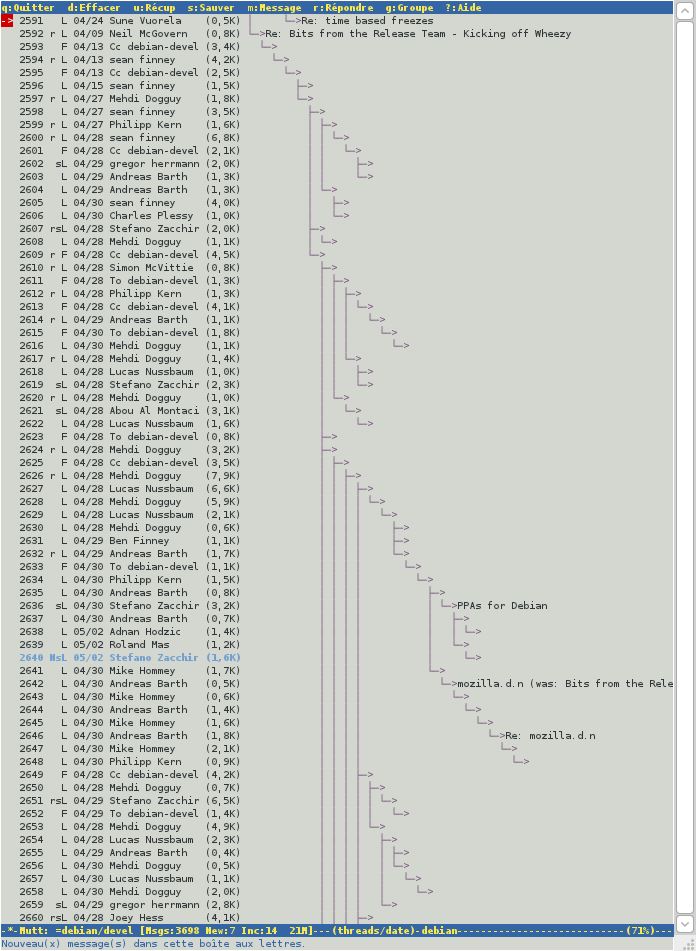
At this point it’s a discussion thread of several hundreds of messages (there are several screens of messages like the one above). Many of the sub-threads have been interesting, but the general discussions mixed too many different things so that there’s no clear outcome yet. Lucas Nussbaum tried to make a summary.

Obviously I must adjust my plan, there’s lots of feedback to process. I accepted to drive a DEP together with Sean Finney to help structure the part of the discussion that focuses on allowing development to continue during freezes. But I’m also eager to fix the marketing problem of testing and have the project recognize that testing is a product in itself and that end-users should be encouraged to use it.

Package Tracking System maintenance

The Package Tracking System is an important tool for Debian developers, and it has been broken by some change on the Bug Tracking System. I worked around it quite quickly so that few people noticed the problem but Cron kept reminding me that I had to properly fix it.

I ended up doing it last week-end. While working on the PTS, I took the opportunity to merge a patch from Jan Dittberner to enhance the news RSS feed that the PTS provides. And I also integrated information from backports.debian.org (thanks to Mehdi Dogguy for reminding me #549115).

Multiarch update

Not much new this month. I fixed two bugs in the multiarch dpkg branch thanks to bug reports from Ubuntu users (LP 767634, LP 756381). I’m still waiting on Guillem Jover finishing his review of the multiarch branch. I’m pinging him from time to time but it looks like multi-arch is no longer in his short term priority list. 🙁

I’ve been running this code for more than 2 months and it works fine. I want to see it merged. I’m ready to update my code should anything need to be changed to please Guillem. But without any feedback we’re in a deadlock.

Misc dpkg work

While fixing a bug in update-alternatives (found in one of the valid reports on launchpad), I noticed that there was room for improvements in the error messages output by update-alternatives. I changed them to reuse the same strings that were already used in other parts of dpkg. The result is that there are a few strings less to translate (always a nice thing for the poor translators who have to deal with the thousands of strings that dpkg contains).

I also tried to fix some of the most cryptic error messages in dpkg (see #621763) but that work is stalled at the request of Guillem.

Book update

We (me and Roland Mas) are almost done with the update of our French book for Debian Squeeze. It will hit the shelves in July or September. I’m starting to prepare the fundraising campaign to make an English translation of it. We’ll use ulule.com for this.

On my blog

I have been pleased to interview Meike Reichle, it’s the first women that I have interviewed in the series but it’s certainly not the last one. I also interviewed Adam D. Barratt, one of our tireless release managers.

Thanks

Many thanks to the people who gave me 180.35 € in March and 235.37 € in April. That represents 1.5 and 2 days of work for those months.

See you next month for a new summary of my activities.

Do we need project-wide support for Debian rolling?

April 29, 2011 by Raphaël Hertzog

The discussion about Debian rolling started sooner than expected on debian-devel (see the thread here). I initially wanted to iron out the biggest problems through discussions on my blog and try to submit a somewhat polished proposal… instead we ended up discussing the same things both on -devel and on my blog.

That said it’s not that bad (except for the time I lost to have similar conversations in both places) because the debian-devel discussions included members of the release team and it looks like they are not fundamentally opposed to the idea.

Despite this, the introduction of a “frozen” suite branched off from “testing/rolling” is not really consensual (yet?). But the idea of officially supporting testing on a best-effort basis appears to have almost no opposition.

While some will undoubtedly believe that this is a useless exercise, I believe it would help if the project stated this in a somewhat official manner. My answer to the question in the title is thus:

YES

I am thus considering to submit a general resolution to that effect. My current draft is below.

Title: Debian endorses usage of testing by end-users, and renames it to rolling

The Debian project recognizes that the Debian testing distribution—initially created to make it easier to prepare and test the next stable release—has become a useful product of its own. It satisfies the needs of users who are looking for the latest stable versions of software and who can cope (or even appreciate) a system that’s constantly evolving.

The Debian project decides to endorse this usage and will strive to provide a good experience to users of “testing”. To better communicate this policy change to our users, “testing” will be renamed “rolling”.

While we believe that this is a good move, we would like to remind our users that Debian is a volunteer project and that our resources are not infinite. Package maintainers are contributing to Debian on a best-effort basis. This means that they might not be able to properly support their package(s) in all distributions. In that case, the project recommends that maintainers apply the following priorities:

  1. Support in stable (security updates, release critical bugs)
  2. Preparation of the next stable release
  3. Support in rolling

Note that this general resolution could have amendments with s/rolling/current/ and that would solve the bikeshedding over the name that started several times already.

I deliberately separated “Preparation of the next stable release” and “Support in rolling” so that priorities are clear even if we decide to not freeze “rolling” and to introduce a “frozen” distribution to finalize the next stable release.

I also did not go into too much details on the implications that it might have, it’s best to leave that up to each contributor/team/etc.

I hesitated to add a paragraph stating that we want to try to gradually improve the usability of testing but in the end I think it would be somewhat redundant. We’re always trying to do our best when we decide to take on something.

All comments welcome (even if you just agree and would be willing to second such a GR).

Update: I will tweak the draft included in this article when I get good suggestions. Thanks to Lucas Nussbaum for the first one.

No freeze of Debian’s development, what does it entail?

April 28, 2011 by Raphaël Hertzog

The main feature of rolling is that it would never freeze. This is not without consequences.

Possible consequences

It can divert developers from working on the release

No freeze means developers are free to continue their work as usual in unstable. Will it be more difficult to release because some people will spend their time working on a new upstream version instead of fixing RC bugs in the version that is frozen? Would we lose the work of the people who do lots of NMU to help with the release?

It makes it more difficult to cherry-pick updates from unstable

No freeze also means that unstable is going to diverge sooner from testing and it will be more difficult to cherry-pick updates from unstable into testing. And the release team likes to cherry-pick updates that have been tested in unstable because updates that comes through testing-proposed-updates have often not been tested and need thus a more careful review.

Frozen earth

My responses to the objections

Those are the two major objections that we’ll have to respond to. Let’s try to analyze them a bit more.

It’s not testing vs rolling

On the first objection I would like to respond that we must not put “testing” and “rolling/unstable” in opposition. The fact that a contributor can’t do its work as usual in unstable does not mean that he will instead choose to work on fixing RC bugs in testing. Probably that some do, but in my experience we simply spend our time differently, either working more on non-Debian stuff or doing mostly hidden work that is then released in big batches at the start of the next cycle (which tends to create problems of its own).

I would also like to argue that by giving more exposure to rolling and encouraging developers to properly support their packages in rolling, it probably means that the overall state of rolling should become gradually better compared to what we’re currently used to with testing.

The objection that rolling would divert resources from getting testing in a releasable shape is difficult to prove and/or disprove. The best way to have some objective data would be to setup a questionnaire and to ask all maintainers. Any volunteer for that?

Unstable as a test-bed for RC bugfixes?

It’s true that unstable will quickly diverge from testing and that it will be more difficult to cherry-pick updates from unstable into testing. This cannot be refuted, it’s a downside given the current workflow of the release team.

But I wonder if the importance of this workflow is not overdone. The reason why they like to cherry-pick from unstable is because it gives them some confidence that the update has not caused other regressions and ensures that testing is improving.

But if they’re considering to cherry-pick an update, it’s because the current package in testing is plagued by an RC bug. Supposing that the updated package has introduced a regression, is it really better to keep the current RC bug compared to trading it for a new regression? It sure depends on the precise bugs involved so that’s why they prefer to know up-front about the regression instead of making a blind bet.

Given this, I think we should use testing-proposed-updates (tpu) as a test-bed for RC bug fixes. We should ask beta-testers to activate this repository and to file RC bugs for any regression. And instead of requiring a full review by a release manager for all uploads to testing-proposed-updates, uploads should be auto-accepted provided that they do not change the upstream version and that they do not add/remove binary packages. Other uploads would still need manual approval by the release managers.

On top of this, we can also add an infrastructure to encourage peer-reviews of t-p-u uploads so that reviews become more opportunistic instead of systematic. Positive reviews would help reduce the aging required in t-p-u before being accepted into testing.

This changes the balance by giving a bit more freedom to maintainers but still keeps the safety net that release managers need to have. It should also reduce the overall amount of work that the release team has to do.

Comments welcome

Do you see other important objections beside the two that I mentioned?

Do you have other ideas to overcome those objections?

What do you think of my responses? Does your experience infirm or confirm my point of view?

Towards Debian rolling: my own Debian CUT manifesto

April 27, 2011 by Raphaël Hertzog

As you might know, I’m of one the people who promote the idea of having a Constantly Usable Testing (CUT). I will post a set of articles on this topic to help me clarify my ideas and to get some early feedback of other Debian contributors. I plan to use the result of this process to kickstart a broader discussion on debian-devel (where I hope to get the release team involved).

Let’s start by defining my own objectives with Debian CUT. I won’t speak of the part of Debian CUT that plans to make regular snapshots of testing with installable media because that’s not where I will invest my time. I do hope other people will do it though. Instead I will concentrate on changes that would improve Debian testing for end-users. I consider that testing (in its current form) is largely usable already but there are two main obstacles to overcome.

Testing without freezes = rolling

The first one is that testing is no longer testing during freezes. The regular flow of new upstream versions—that makes testing so interesting for many users—is stalled because we’re using testing to finalize the next stable version. That’s why I’d like to introduce a new suite called “rolling” that would work like the current testing except that it never freezes. Testing would no longer be a permanent suite, it would only exist during the freeze and it would be branched off from rolling.

Rolling should be a supported distribution

The second obstacle is not really technical. We must advertise rolling as a distribution that ordinary people can use but we should make it clear that it’s never going to have the same level of polish that a stable release can have. And to back up this assertion, we must empower Debian developers to be able to provide good support of their software in rolling, this probably means using “rolling-proposed-updates” more often to push fixes and security updates when the natural flow of updates is blocked by transitions or other problems. Some maintainers won’t have the time required to provide the same level of support as they currently do for a stable release and that’s okay, it’s not worse than the current testing. The goal is to treat it on a best-effort basis and to try to gradually improve the situation.

My goal for wheezy

This is the the minimal implementation of CUT that I would like to target in the wheezy timeframe. Having testing as a temporary branch of rolling is not a strict requirement, although I’d argue that it’s important to not waste resources towards maintaining two separate yet very similar distributions.

Should Debian embrace those goals?

Ignoring all possible problems that will surface while trying to implement those goals, can we agree that Debian should embrace those goals because it means providing a better service to a class of users that is not satisfied by the current stable release?

I will come back to the expected problems in a subsequent post and we will have the opportunity to discuss them. Here I just want to see whether we can have broad buy-in on the principles behind Debian rolling and CUT.

  • « Previous Page
  • 1
  • …
  • 61
  • 62
  • 63
  • 64
  • 65
  • …
  • 95
  • Next Page »

Get the Debian Handbook

Available as paperback and as ebook.
Book cover

Email newsletter

Get updates and exclusive content by email, join the Debian Supporters Guild:

Follow me

  • Email
  • Facebook
  • GitHub
  • RSS
  • Twitter

Discover my French books

Planets

  • Planet Debian

Archives

I write software, books and documentation. I'm a Debian developer since 1998 and run my own company. I want to share my passion and knowledge of the Debian ecosystem. Read More…

Tags

3.0 (quilt) Activity summary APT aptitude Blog Book Cleanup conffile Contributing CUT d-i Debconf Debian Debian France Debian Handbook Debian Live Distro Tracker dpkg dpkg-source Flattr Flattr FOSS Freexian Funding Git GNOME GSOC HOWTO Interview LTS Me Multiarch nautilus-dropbox News Packaging pkg-security Programming PTS publican python-django Reference release rolling synaptic Ubuntu WordPress

Recent Posts

  • Debian’s General Resolution on AI and LLM
  • How to choose your SSH agent with Wayland and systemd
  • Freexian is looking to expand its team with more Debian contributors
  • Freexian’s report about Debian Long Term Support, July 2022
  • Freexian’s report about Debian Long Term Support, June 2022

Copyright © 2005-2021 Raphaël Hertzog