apt-get install debian-wizard

Insider infos, master your Debian/Ubuntu distribution

  • About
    • About this blog
    • About me
    • My free software history
  • Support my work
  • Get the newsletter
  • More stuff
    • Support Debian Contributors
    • Other sites
      • My company
      • French Blog about Free Software
      • Personal Website (French)
  • Mastering Debian
  • Contributing 101
  • Packaging Tutorials
You are here: Home / Archives for 2012

Archives for 2012

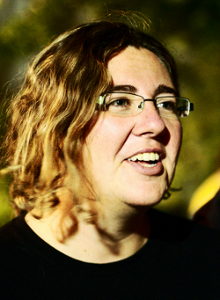
People behind Debian: Ana Beatriz Guerrero López, member of the Debian KDE team

February 10, 2012 by Raphaël Hertzog

If you met Ana, you’ll easily remember her. She has a great and pronounced Spanish accent… 🙂 I’m glad that the existence of the Debian Women project helped her to join Debian because she has been doing a great job.

From KDE packaging to publicity/marketing work, her interests shifted over the years but this allowed her to stay very involved. As she explains it very well, Debian is big enough so that you can stop doing something which is no longer fun for you, and still find something new to do in another part of Debian!

Read on to learn more about Ana, the KDE team, Debian’s participation to the Google Summer of Code, and more.

Raphael: Who are you?

Ana: I’m Ana Guerrero López and I’m in my early 30s. I was born and raised in the wonderful city of Sevilla, Spain and I live in Lyon, France. I share my life with another Debian Developer and my paid work is doing Debian support and integration, so you won’t be surprised to read that Debian is a big part of my life.

Raphael: How did you start contributing to Debian?

Ana: Although I knew about the existence of Linux since 1997 or so, I didn’t really start using Linux until the summer 2001 when I finally got a computer on my own and an Internet link at home. In the beginning, I was using Mandrake in a dual boot with Windows and later around 2003, I happily moved to only using Debian and ditching the Windows partition. Once settled as a Debian user, I knew anybody could help improve the distribution but I hesitated to join mostly due to two reasons, my perception of Debian was the one of a very elitist and aggressive club and who wants to join this kind of cult^wproject? And even if I wanted to join, I did not know how to get started.

By the summer of 2004, the Debian Women project started, it made me seeing Debian as a more welcoming project, and I started maintaining my first packages. The following summer 2005, I attended akademy 2005 (the annual KDE conference) where I had the pleasure to meet there some of the people from the KDE team and this really made a difference for me. Christopher Martin and Adeodato Simó, with the help of other people, have started the maintenance of KDE as a team a few months before and by that time most of the KDE modules where under the maintenance umbrella of the team. This was a very good move since it allowed easily to share the KDE maintenance in a more coordinated way and also eased having non-DDs, like me at that time, to join in and help.

The Debian Women project started, it made me seeing Debian as a more welcoming project.

Raphael: You’re part of the Debian KDE team. What’s your role in the team and what are your plans for Wheezy?

Ana: Nowadays, I am not as active in the KDE team as I used to be in the past. The KDE 3 to KDE 4 transition was quite tiring and changes on the KDE side like the successive marketing renames, the shorter 6 months schedule (it used to be at least 9) or the uncoordinated KDE releases mostly burnt me out. Currently, I am mostly working in helping others to get started within the team, some small fixes here and there, and helping with the uploads: an upload of the full KDE suite to the archive requires some building power and upload bandwidth not everybody have.

For Wheezy, with the tentative freeze date in June, the plan is to try to ship the latest possible point release of the KDE 4.8 series. The first release of the series, 4.8.0 was released a couple of weeks ago and while writing these lines, the packaging work for 4.8 hasn’t started yet. The next move for the team is getting 4.7.4 in unstable, currently sitting in experimental.

For Wheezy, […] the plan is to try to ship the latest possible point release of the KDE 4.8 series.

Besides the KDE packages, there is some software which users perceive as KDE, such as amarok, digikam, etc., which are not part of KDE but fall under its umbrella. These other programs have their own maintainers and their updates depend greatly in the availability of them. For the KDE office suite, we have right now KOffice in the archive. KOffice got a fork some time ago named Calligra and we should replace KOffice by Calligra in the archive before the release of Wheezy. Sadly there isn’t yet a final release of Calligra to use.

My personal goal for Wheezy was to finish the removal of all the remaining packages depending on KDE 3 and Qt 3 that Squeeze still contained. The removal of the KDE 3 libraries and all the packages using them was quickly achieved after the release of Squeeze. The removal of Qt 3 soon showed that it was task harder than expected since some popular packages (sometimes not in the Debian archive, e.g. third-party scientific software) depend on it, and also Qt 3 is a requirement for LSB compatibility. Right now, Qt 3 has been orphaned for 9 months and nobody has shown any interest in adopting it.

Raphael: KDE, much like GNOME, has been forked by people who were unhappy by the direction that the project has taken since version 4 (cf Trinity). What’s your personal opinion on KDE 4.x and what’s the position of the Debian KDE team concerning this fork?

Ana: I use KDE 4 on my laptop and I think it is a solid desktop environment and platform. However I am finding it less and less attractive for me. On one side, my usage of the computer has been slightly changing and on the other side, I do not like how the new developments in KDE are evolving, things like plasmoids or activities are not attractive for me. I have switched my other 2 systems to awesome although I continue to use mainly a bunch of KDE applications: dolphin, konsole, kate, juk, kmix, etc. So you might say my desktop environment is an awesome KDE.

Regarding the Trinity project, a lot of users complained very loudly when KDE 3 got replaced by KDE 4 in testing/unstable, so I find quite laudable the decision of some users to act instead and try to continue with a forked development of KDE 3. However the Trinity team seems to be about 3 persons (funny for a project named Trinity :)) while KDE 3 is big. In perspective, it does not look that big because KDE 4 is even larger, but it is still too much for such small team. In addition those developers need to maintain Qt3 that has been end-of-lifed years ago by Nokia/Trolltech¹. So my guess is that sooner or later the project will fade away.

Nobody from the KDE team is interested in Trinity and in case someone wants to package it for Debian, they would have to make a new team. For the reasons mentioned above: Qt3 maintenance and reduced upstream group, this would be a bad idea.

My advice if you do not like KDE 4 and you miss KDE 3, would be taking a look at razor-qt based on Qt4 and quite similar to KDE 3.

¹ I read they have plans to port it to Qt4, but frankly that could take some years… same it took to the KDE project for KDE 4.0.0 😉

Raphael: You used to maintain news.debian.net, a WordPress blog dedicated to Debian, but you stopped a while ago. A few months later you started to maintain a Debian page on Google+. Why did you stop the blog and what’s your goal with the Google+ page?

Ana: I blogged about the reasons I started news.debian.net. In short, I thought Debian needed a better system to publish news, something like a blog. I first tried to suggest the idea to the press/publicity team but they weren’t interested, so I started the project alone. IMHO the blog worked quite well and I was feeling like it should be made official. I talked about this with some people but at the time I wasn’t pushing it because I had other priorities and I knew pushing it to become official would need some extra time and energy.

Stefano decided to start the discussion about making news.debian.net official (that’s moving it to a debian.org domain) in its own initiative. After the public discussion and some private exchange of emails with DSA, the situation became frustrating and I decided to close news.debian.net after the release of Squeeze.

Later, during DebConf, an officer from the press team announced they were launching a blog and I asked Stefano if he could try to have a discussion about this to see if it could still somehow fit my ideas, and maybe contributing myself, but nobody from the press team answered Stefano’s email and the blog hasn’t started yet either.

Irony that communication didn’t work when wanting to improve communication.

About the Google+ page, everyday I follow what is going in Debian and quite often I find things I want to share. I do not want to clutter my own profiles with Debian stuff or have people following me because of that, so I decided to create the Debian page when Google+ made them available. I like the fact that people can follow that without having an account in Google+ although they can not comment anonymously. I am not happy about the fact that Google+ is a closed platform but hopefully the data will become easier to export in the near future. Right now, there are some services that provides RSS feeds of Google+ pages if you want to follow the page and you are not in Google+ (or I could setup one if several people ask me).

Raphael: Last year you helped to manage Debian’s participation to the Google Summer of Code. How did it went? Is there something that you can improve for this year?

Ana: I think last year we managed to have people in Debian more aware about what the students were doing. That also helped students to get more feedback and therefore get to know more people in the project and get more integrated. Students were sending periodic public reports available to everybody interested in the status of the projects and some of them also held their own sessions in DebConf.

We still failed to start looking for mentors early enough and to give them information about how the GSoC worked and how they could have a successful project. Having good projects in Debian is harder than in other projects because the GSoC mostly promotes having students started in Open Source *coding* for a project, while Debian is more a project about integrating software and we overall do not have so many parts that has to be coded.

My personal goal for this year is to try getting the projects earlier to attract good students from the very beginning, even if that means we have less projects than in other years.

Raphael: What motivates you to continue to contribute year after year?

Ana: Three things. I like improving the OS I use, I like the friends I have made while working in Debian through the years and because I have fun.

Also Debian is quite a big project, so if you become tired or burn out working in some area, you always can easily find interesting things to do somewhere else.

Raphael: Is there someone in Debian that you admire for their contributions?

Ana: Adeodato Simó, he is now in a long leave from the project, but it is one of those persons who made a difference in the project in his job in the release team some years ago. Aurélien Jarno because of his tireless work in (e)glibc and porting of several architectures.

I also have special admiration for all those people who have been very active in the project for more than 7-8 years because I know it is not always easy to combine it with real life.


Thank you to Ana for the time spent answering my questions. I hope you enjoyed reading her answers as I did. Note that older interviews are indexed on wiki.debian.org/PeopleBehindDebian.

Subscribe to my newsletter to get my monthly summary of the Debian/Ubuntu news and to not miss further interviews. You can also follow along on Identi.ca, Google+, Twitter and Facebook

.

Dpkg with multiarch support available in Debian experimental

February 7, 2012 by Raphaël Hertzog

As I announced on debian-devel, Guillem Jover uploaded a snapshot of dpkg’s multiarch branch to experimental (version 1.16.2~wipmultiarch). Beware: There will
likely be some small “interface” changes between this version and the version that will be released later in unstable (possibly in the output of dpkg --get-selections, dpkg --list, maybe other commands).

multiarch allows you to install packages from different architectures on the same machine. This can be useful if your computer can run programs from 2 architectures (eg. x86 CPU supporting i386 and amd64), or if you often need to cross-compile software and thus need the libraries of your target architecture.

Test dpkg with multiarch support

If you want to test multiarch support in dpkg, install the package from experimental (apt-get install dpkg/experimental assuming you have experimental in your sources.list).

Then you can add a supplementary architecture to your system by doing sudo dpkg --add-architecture <arch> (e.g. i386 if you are on amd64, and vice-versa). APT will automatically pick up the new architecture and start downloading the Packages file for the new architecture (it uses dpkg --print-foreign-architectures to know about them).

From there on you can install packages from the “foreign” architectures with “apt-get install foo:<arch>“. Many packages will not be installable because some of their dependencies have not yet been updated to work with in a multiarch world (libraries must be installed in a multiarch-compliant path so as to be co-installable, and then marked “Multi-Arch: same“). Other dependencies might need to be marked “Multi-Arch: foreign“. See wiki.debian.org/Multiarch/Implementation for more HOWTO-like explanations.

Now is a good time to see if you can install the foreign packages that you could need in such a setup and to help to convert the required libraries.

You can also read Cyril Brulebois’ article which quickly shows how to hunt for the problematic packages which have not been converted to multiarch (in his sample, “ucf” is not ready. Since it’s an “Architecture: all” package which can run on any architecture, it means that it’s lacking a “Multi-Arch: foreign” field).

Report bugs

If you discover any bug in dpkg’s multiarch implementation, please report it to the Bug Tracking System (against “dpkg” with the version “1.16.2~wipmultiarch”).

If you notice important libraries or packages which are not yet multiarch ready, please open wishlist bug reports requesting the conversion and point the maintainers towards the wiki page linked above. Even better, prepare patches and submit those with your bug reports.

Again, you can follow the lead of Cyril Brulebois who filed 6 bugs!

Review the multiarch implementation

If you’re a C programmer and have some good knowledge of dpkg (or are willing to learn more of it), we would certainly benefit from more eyes reviewing the multiarch branch. If you want to discuss some design issues of the multiarch implementation in dpkg (or have questions related to your review), please get in touch via debian-dpkg@lists.debian.org.

The latest version of the branch is pu/multiarch/master in Guillem’s personal repository. I have my own version of the branch (pu/multiarch/full) which is usually a snapshot of Guillem’s branch with my own submitted fixes.

$ git clone git://git.debian.org/dpkg/dpkg.git
$ cd dpkg
$ git remote add guillem git://git.hadrons.org/git/debian/dpkg/dpkg.git
$ git remote add buxy git://git.debian.org/~hertzog/dpkg.git
$ git fetch guillem && git fetch buxy

If you followed the instructions above, the relevant branches are thus guillem/pu/multiarch/master and buxy/pu/multiarch/full. Both branches are regularly rebased on top of master where Guillem merges progressively the commits from the multi-arch branch as his review progresses.

Thank you in advance for your help bringing multiarch in shape for Debian Wheezy,

My Debian Activities in January 2012

February 1, 2012 by Raphaël Hertzog

This is my monthly summary of my Debian related activities. If you’re among the people who made a donation to support my work (213.68 €, thanks everybody!), then you can learn how I spent your money. Otherwise it’s just an interesting status update on my various projects.

Dpkg

The “biggest change” I made is a small patch that brings to an end years and years of recurring discussions about the build-arch and build-indep targets of debian/rules (see #229357). Last year the technical committee took this issue in its hands (see #629385) but it failed to take any resolution. Fortunately thanks to this we got some concrete numbers on the colateral damages inflicted on the archive for each possible approach. In the end, Guillem and I managed to agree on the way forward.

The remaining of what I did as dpkg maintainer has not much to do with coding. I reviewed the work of Gianluca Ciccarelli on dpkg-maintscript-helper who is trying to provide helper functions to handle migration between directories and symlinks. I also reviewed a 2000-lines patch from Patrick Schoenfeld who’s trying to provide a perl API to parse dpkg log files and extract meaningful data out of them.

I updated the dpkg-architecture manual page to document the Makefile snippet /usr/share/dpkg/architecture.mk and to drop information that’s no longer releveant nowadays.

I reviewed a huge patch prepared by Russ Allbery to update the Debian policy and document the usage of symbols files for libraries. As the author of dpkg-gensymbols, I was keen to see it properly documented at the policy level.

I brought up for discussion a detail that was annoying me for quite some time: some copyright notices were embedded in translatable strings and updating them resulted in useless work for translators. In the end we decided to drop those notices and to keep them only at the source level.

I updated my multiarch branch on top of Guillem’s branch several times, all the fixes that were in my branch have been integrated (often in a modified form).

Unfortunately even if the code works quite well, Guillem doesn’t want to release anything to Debian until he has finished to review everything… and many people are annoyed by the unreasonable delay that it imposes. Cyril Brulebois tried to release a snapshot of the current multiarch branch to experimental but Guillem has been prompt to revert this upload.

I’m somewhat at a loss in this situation. I offered my help to Guillem multiple times but he keeps doing his work in private, he doesn’t share many details of his review except some comments in commit logs or when it affects the public interface. I complained once more of this sad situation.

Debian Package Maintenance Hub

That’s the codename I use for a new infrastructure that I would like to develop to replace the Package Tracking System and the DDPO and several other services. I started to draft a Debian Enhancement Proposal (DEP), see DEP-2, and requested some comments within the QA team.

For now, it looks like that nobody had major objections on the driving idea behind this project. Those who commented were rather enthusiastic. I will continue to improve this DEP within the QA team and at some point I will bring the discussion to a larger audience like debian-devel@lists.debian.org.

Package Tracking System

Even if I started to design its replacement, the PTS will still be used for quite some time so I implemented two new features that I deemed important: displaying a TODO notice when there is (at least) one open bug related to a release goal, displaying a notice when the package is involved in an ongoing or upcoming transition.

Misc packaging tasks

I created and uploaded the dh-linktree package which is a debhelper addon to create symlink trees (useful to replace embedded copies of PHP/JavaScript libraries by symlinks to packaged copies of those files).

I packaged quilt 0.50. I helped the upstream authors to merge a Debian patch that had been forwarded by Martin Quinson (a quilt’s co-maintainer). I packaged a security release of WordPress (3.3.1) and a new upstream release of feed2omb and gnome-shell-timer.

I prepared a new Debian release of python-django with a patch cherry-picked from the upstream SVN repository to fix the RC bug #655666.

Book update

We’re again making decent progress in the translation of the Debian Administrator’s Handbook, about 12 chapters are already translated.

The liberation campaign is also (slowly) going forward. We’re at 72% now (thanks to 63 new supporters!) while we were only at 67% at the start of January.

Thanks

See you next month for a new summary of my activities.

Contributing to the translation of Debian

January 31, 2012 by Raphaël Hertzog

If you’re not into packaging and if you asked how you could help Debian, someone probably suggested that you help to translate it.

It’s true that translating Debian is essential if we want to make Debian available to everybody on the world. There are many persons who are stuck as soon as they get a message in English, so it’s important to aim for 100% coverage in terms of localization.

Some vocabulary: localization vs internationalization

Internationalization (i18n) is the work that makes it possible to translate messages in a given application.

Localization (l10n) is the work of translating messages of said application. So as a translator, you’ll be doing “localization” but some knowledge of “internationalization” is still useful… because it will define how you’re supposed to provide the translations. We’ll come back to that later.

Join your localization team

Usually the translation work is shared among multiple translators within a localization team. Check out the Debian International page on www.debian.org to find out instructions for translators for each language.

Many teams have a debian-l10n-*@lists.debian.org mailing list used for coordination, feel free to ask questions on those lists when you start (but make sure that you have read the relevant documentation before).

Each team has its own workflow, so observe for a while to get used to what’s happening before asking your first questions.

What is there to translate?

The translation of most of the software provided by Debian is not handled by Debian. The Debian translation teams “only” handle the translation of:

  • the software that are specific to Debian (debian-installer, dpkg, APT, etc.) (*);
  • the Debconf prompts in all Debian packages (*);
  • the Debian documentation (*);
  • the Debian website;
  • the Debian wiki;
  • the descriptions of packages.

Now before contributing to your first translation, I have to come back to internationalization to teach you a few things. In the above list, the projects marked with “(*)” do use PO files for their translation and the next sections will explain you how to work with those files.

Introduction to Gettext

The free software community has mostly standardized on a single internationalization infrastructure known as Gettext. With this tool, you’re provided a “POT file” which contains all the translatable strings. It looks like this:

# SOME DESCRIPTIVE TITLE.
# Copyright (C) YEAR Software in the Public Interest, Inc.
# This file is distributed under the same license as the PACKAGE package.
# FIRST AUTHOR , YEAR.
#
#, fuzzy
msgid ""
msgstr ""
"Project-Id-Version: dpkg 1.16.1\n"
"Report-Msgid-Bugs-To: debian-dpkg@lists.debian.org\n"
"POT-Creation-Date: 2011-09-23 03:37+0200\n"
"PO-Revision-Date: YEAR-MO-DA HO:MI+ZONE\n"
"Last-Translator: FULL NAME \n"
"Language-Team: LANGUAGE \n"
"Language: \n"
"MIME-Version: 1.0\n"
"Content-Type: text/plain; charset=UTF-8\n"
"Content-Transfer-Encoding: 8bit\n"
"Plural-Forms: nplurals=INTEGER; plural=EXPRESSION;\n"

#: lib/dpkg/ar.c:66
#, c-format
msgid "invalid character '%c' in archive '%.250s' member '%.16s' size"
msgstr ""

#: lib/dpkg/ar.c:81 lib/dpkg/ar.c:97 lib/dpkg/ar.c:108 lib/dpkg/ar.c:112
#: lib/dpkg/ar.c:134 utils/update-alternatives.c:1154
#, c-format
msgid "unable to write file '%s'"
msgstr ""

[…]

The lines starting with “#:” are comments that indicate the source files where the (English) string is used. This can be useful if you want check the source to have more information about how the string is used.

The lines starting with “#,” contain flags that can be important. If the “fuzzy” flag is set, the translated string is not used because it must be updated (or at least verified) since the original string evolved. The “c-format” flags indicates that the string must be a C format string, this has some implications in what’s allowed in the string (in particular when it embeds conversion specifier for arguments submitted to printf-like functions).

Another thing to note is that the translation of the empty string is used to store some meta-information about the translation itself.

Contributing a translation as a PO file

When you start a new translation, you copy that POT file to create a “PO file” for your own language (eg. fr.po for the French language). You replace some template values (identified with the upper case words in the POT file) and you replace all the empty strings on “msgstr” lines with the translation of the string that appears in the previous “msgid” line.

The result could be something like this:

# translation of fr.po to French
# Messages français pour dpkg (Linux-GNU Debian).
msgid ""
msgstr ""
"Project-Id-Version: fr\n"
"Report-Msgid-Bugs-To: debian-dpkg@lists.debian.org\n"
"POT-Creation-Date: 2011-09-23 03:37+0200\n"
"PO-Revision-Date: 2012-01-16 07:57+0100\n"
"Last-Translator: Christian Perrier \n"
"Language-Team: French \n"
"Language: fr\n"
"MIME-Version: 1.0\n"
"Content-Type: text/plain; charset=UTF-8\n"
"Content-Transfer-Encoding: 8bit\n"
"Plural-Forms: Plural-Forms: nplurals=2; plural=n>1;\n"
"X-Generator: Lokalize 1.2\n"

#: lib/dpkg/ar.c:66
#, c-format
msgid "invalid character '%c' in archive '%.250s' member '%.16s' size"
msgstr "caractère invalide « %1$c » dans la taille du membre « %3$.16s » de l'archive « %2$.250s »"

#: lib/dpkg/ar.c:81 lib/dpkg/ar.c:97 lib/dpkg/ar.c:108 lib/dpkg/ar.c:112
#: lib/dpkg/ar.c:134 utils/update-alternatives.c:1154
#, c-format
msgid "unable to write file '%s'"
msgstr "impossible d'écrire le fichier « %s »"

[…]

If there’s already a “PO file” for your language, there might still work to do: there might be strings that have not yet been translated and there might be “fuzzy” strings which have to be updated — strings which were already translated but where the original string has been modified.

There are software that can assist you to edit PO files: poedit, virtaal, lokalize, gtranslator. There are also special extensions for vim (packaged in vim-scripts) and for Emacs.

Submit the translation for inclusion

Once you have a complete PO file, you should submit it for inclusion. Sometimes you will have been granted commit rights to the source code repository so that you can include your translation by yourself. In the other cases, you should submit your translation with a bug report tagged “l10n” and someone else will include your work in the next release.

Depending on the team, the workflow might require a review before the submission. In that case, you usually have to send a call for review on the coordination mailing list.

Go ahead!

Hopefully those explanations will be enough to get you started. There are many other things to learn¹ but it’s good to learn while practicing…

¹ For example, can you find out why the French translation above changed “%c” in “%1$c”?

Do you want to read more tutorials like this one? Click here to subscribe to my free newsletter, you can opt to receive future articles by email.

  • « Previous Page
  • 1
  • …
  • 4
  • 5
  • 6
  • 7
  • 8
  • Next Page »

Get the Debian Handbook

Available as paperback and as ebook.
Book cover

Email newsletter

Get updates and exclusive content by email, join the Debian Supporters Guild:

Follow me

  • Email
  • Facebook
  • GitHub
  • RSS
  • Twitter

Discover my French books

Planets

  • Planet Debian

Archives

I write software, books and documentation. I'm a Debian developer since 1998 and run my own company. I want to share my passion and knowledge of the Debian ecosystem. Read More…

Tags

3.0 (quilt) Activity summary APT aptitude Blog Book Cleanup conffile Contributing CUT d-i Debconf Debian Debian France Debian Handbook Debian Live Distro Tracker dpkg dpkg-source Flattr Flattr FOSS Freexian Funding Git GNOME GSOC HOWTO Interview LTS Me Multiarch nautilus-dropbox News Packaging pkg-security Programming PTS publican python-django Reference release rolling synaptic Ubuntu WordPress

Recent Posts

  • How to choose your SSH agent with Wayland and systemd
  • Freexian is looking to expand its team with more Debian contributors
  • Freexian’s report about Debian Long Term Support, July 2022
  • Freexian’s report about Debian Long Term Support, June 2022
  • Freexian’s report about Debian Long Term Support, May 2022

Copyright © 2005-2021 Raphaël Hertzog